支 (zhī) means "to support; to pay; (measure word for pens)" in Chinese. It has 4 strokes with the radical 支, and is HSK Level 3.
Rated 2/5 in difficulty (beginner-friendly).
Harder than 1% of HSK Level 3 characters.
Appears in 3+ common words including 支持 (zhī chí), 支付 (zhī fù), 一支笔 (yī zhī bǐ).
In the Hanzi Writer app, most learners master 支 within 3 practice attempts using stroke-by-stroke animation.
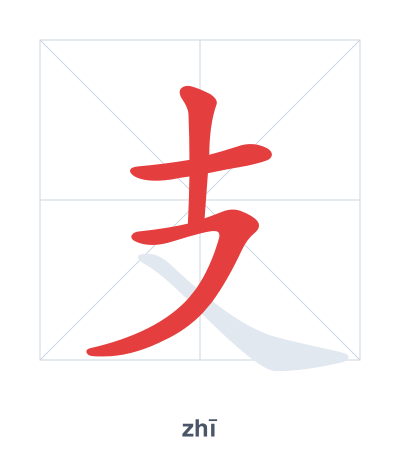
Open Hanzi Writer to see the animated stroke order and practice writing 支 with real-time feedback.
The character 支 (zhī) is written with 4 strokes. Follow the standard Chinese stroke order: top to bottom, left to right, outside before inside. The radical 支 is one of its key components.
Practice the correct stroke order with the Hanzi Writer app to see animated stroke-by-stroke guidance with real-time feedback.
支 means to support; to pay; (measure word for pens).
As an HSK Level 3 character, 支 is an intermediate-level character.
支's ancient form shows a hand (又) grasping a branch, representing the idea of support and extension. Later, it evolved to mean 'to support' or 'to pay' (as in handling out money), and as a measure word for long thin objects like pens, reflecting the branch-like shape.
💡 Memory Tip: Picture a hand (又) holding a pen (the top 十 as the pen's body) to support your writing.
谢谢你支持我的工作。
xiè xiè nǐ zhī chí wǒ de gōng zuò
Thank you for supporting my work.
我可以用手机支付吗?
wǒ kě yǐ yòng shǒu jī zhī fù ma
Can I pay with my phone?
桌子上有一支笔。
zhuō zi shàng yǒu yī zhī bǐ
There is a pen on the table.
Open Hanzi Writer to see the animated stroke order and practice writing 支 with real-time feedback.
✨ Animated stroke order · Handwriting recognition · HSK-graded practice · Free to use
支 is made of 十 (ten) on top and a modified 又 (hand) below, representing a hand holding a branch. This image of supporting a branch gives the character its meanings of 'to support' and 'to pay' (as in offering something). The radical is the character itself, making it a simple self-contained unit.