迢 (tiáo) means "remote" in Chinese. It has 8 strokes with the radical 辶.
Rated 3.7/5 in difficulty (challenging).
Appears in 3+ common words including 千里迢迢 (qiān lǐ tiáo tiáo), 路途迢迢 (lù tú tiáo tiáo), 迢迢 (tiáo tiáo).
Due to its 8 strokes, Hanzi Writer's error detection shows 迢 requires focused practice — most learners need 10+ attempts for consistent accuracy.
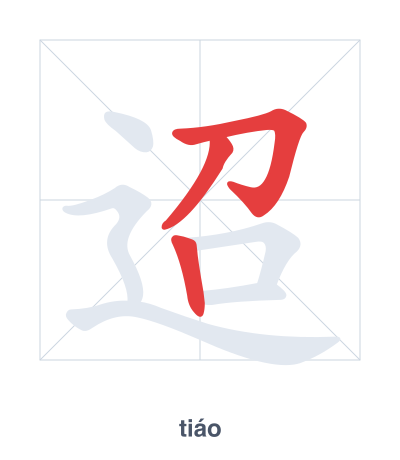
Open Hanzi Writer to see the animated stroke order and practice writing 迢 with real-time feedback.
The character 迢 (tiáo) is written with 8 strokes. Follow the standard Chinese stroke order: top to bottom, left to right, outside before inside. The radical 辶 is one of its key components.
Practice the correct stroke order with the Hanzi Writer app to see animated stroke-by-stroke guidance with real-time feedback.
迢 means remote.
迢 combines the radical 辶 (footsteps or path) with 召 (to summon), suggesting a path that calls one to a distant place. The character originally depicted the idea of traveling far away, as if being summoned from afar.
💡 Memory Tip: Imagine walking (辶) endlessly to answer a distant call (召), making the journey feel remote.
他千里迢迢来看望我。
tā qiān lǐ tiáo tiáo lái kàn wàng wǒ
He came from thousands of miles away to visit me.
前方路途迢迢,请多保重。
qián fāng lù tú tiáo tiáo qǐng duō bǎo zhòng
The road ahead is long; please take care.
星光迢迢,夜色很美。
xīng guāng tiáo tiáo yè sè hěn měi
The starlight is distant, and the night is beautiful.
Open Hanzi Writer to see the animated stroke order and practice writing 迢 with real-time feedback.
✨ Animated stroke order · Handwriting recognition · HSK-graded practice · Free to use
迢 is made of two parts: the radical 辶 (walk) on the left and 召 (call) on the right. The 辶 radical indicates movement or travel, while 召 provides the sound tiáo. Together, they suggest the idea of going to a faraway place, like answering a call from a distance.