疰 (zhù) means "chronic illness" in Chinese. It has 10 strokes with the radical 疒.
Rated 4.2/5 in difficulty (advanced).
Appears in 3+ common words including 疰夏 (zhù xià), 疰船 (zhù chuán), 疰车 (zhù chē).
Due to its 10 strokes, Hanzi Writer's error detection shows 疰 requires focused practice — most learners need 10+ attempts for consistent accuracy.
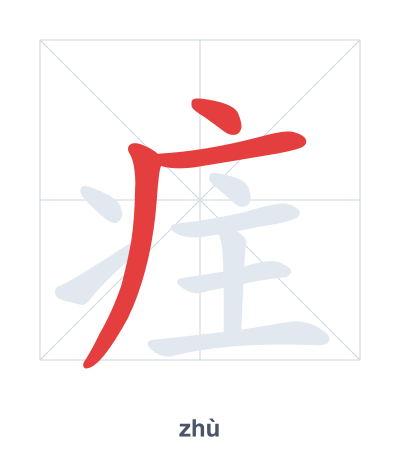
Open Hanzi Writer to see the animated stroke order and practice writing 疰 with real-time feedback.
The character 疰 (zhù) is written with 10 strokes. Follow the standard Chinese stroke order: top to bottom, left to right, outside before inside. The radical 疒 is one of its key components.
Practice the correct stroke order with the Hanzi Writer app to see animated stroke-by-stroke guidance with real-time feedback.
疰 means chronic illness.
It combines the radical 疒 (illness, showing a person lying on a bed) with 主 (host, also providing the sound zhǔ), indicating a chronic illness that 'hosts' or persists in the body.
💡 Memory Tip: Imagine a master (主) chained to a sickbed (疒) forever suffering from a chronic illness.
很多孩子容易疰夏。
hěn duō hái zi róng yì zhù xià
Many children are prone to summer fatigue or loss of appetite in summer.
他坐船的时候会疰船。
tā zuò chuán de shí hòu huì zhù chuán
He gets seasick when he takes a boat.
我从小就容易疰车。
wǒ cóng xiǎo jiù róng yì zhù chē
I've been prone to motion sickness since I was a child.
Open Hanzi Writer to see the animated stroke order and practice writing 疰 with real-time feedback.
✨ Animated stroke order · Handwriting recognition · HSK-graded practice · Free to use
The character 疰 is made of the radical 疒 (illness) on the left and the component 主 (master) on the right. The radical shows it relates to disease, and 主 suggests the illness is "hosting" or staying in the body for a long time, leading to a chronic condition.