疱 (pào) means "blister" in Chinese. It has 10 strokes with the radical 疒.
Rated 4.2/5 in difficulty (advanced).
Appears in 3+ common words including 水疱 (shuǐ pào), 疱疹 (pào zhěn), 起疱 (qǐ pào).
Due to its 10 strokes, Hanzi Writer's error detection shows 疱 requires focused practice — most learners need 10+ attempts for consistent accuracy.
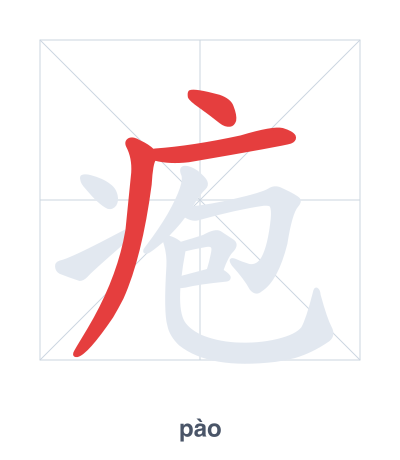
Open Hanzi Writer to see the animated stroke order and practice writing 疱 with real-time feedback.
The character 疱 (pào) is written with 10 strokes. Follow the standard Chinese stroke order: top to bottom, left to right, outside before inside. The radical 疒 is one of its key components.
Practice the correct stroke order with the Hanzi Writer app to see animated stroke-by-stroke guidance with real-time feedback.
疱 means blister.
疱 is a compound character with the radical 疒 (illness) indicating a skin condition, and the component 包 (bāo, meaning 'to wrap') providing phonetic and semantic hints. The idea is a blister as a small pocket of fluid wrapped under the skin, like a package of sickness.
💡 Memory Tip: Imagine a sick person (疒) with a wrapped package (包) on their skin that pops into a painful blister.
我的脚上长了水疱。
wǒ de jiǎo shàng zhǎng le shuǐ pào
I have a blister on my foot.
医生说这是带状疱疹。
yī shēng shuō zhè shì dài zhuàng pào zhěn
The doctor said this is shingles.
烫伤的地方起疱了。
tàng shāng de dì fāng qǐ pào le
The scalded area has blistered.
Open Hanzi Writer to see the animated stroke order and practice writing 疱 with real-time feedback.
✨ Animated stroke order · Handwriting recognition · HSK-graded practice · Free to use
The character 疱 has the radical 疒 (illness) on the outside, showing it relates to a medical condition. Inside is 包 (bāo, meaning "to wrap" or "package"), suggesting a blister is a pocket of fluid wrapped under the skin.