肚 (dǔ/dù) means "Belly; stomach." in Chinese. It has 7 strokes with the radical 月, and is HSK Level 4.
Rated 3.5/5 in difficulty (challenging).
Harder than 36% of HSK Level 4 characters.
Appears in 4+ common words including 肚子 (dǔ zi), 腹肚 (fù dù), 牛肚 (niú dǔ).
Due to its 7 strokes, Hanzi Writer's error detection shows 肚 requires focused practice — most learners need 10+ attempts for consistent accuracy.
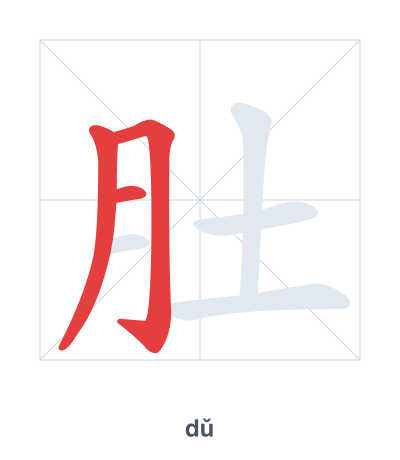
Open Hanzi Writer to see the animated stroke order and practice writing 肚 with real-time feedback.
The character 肚 (dǔ/dù) is written with 7 strokes. Follow the standard Chinese stroke order: top to bottom, left to right, outside before inside. The radical 月 is one of its key components.
Practice the correct stroke order with the Hanzi Writer app to see animated stroke-by-stroke guidance with real-time feedback.
肚 means Belly; stomach..
This is a polyphonic character with readings: dǔ, dù.
As an HSK Level 4 character, 肚 is an intermediate-level character.
肚 is a phono-semantic compound where the radical 月 (flesh/body) indicates a body part, and 土 (earth/soil) provides the approximate sound. The belly is conceived as a fleshy mound or 'earth' on the body.
💡 Memory Tip: Imagine a belly (月) bulging out like a round mound of earth (土).
吃完冰淇淋后,他的肚子感到有些不舒服。
chī wán bīng qí lín hòu tā de dǔ zi gǎn dào yǒu xiē bù shū fú
After eating ice cream, his stomach felt a bit uncomfortable.
这只小猫的腹肚上长着雪白的毛。
zhè zhǐ xiǎo māo de fù dù shàng zhǎng zhe xuě bái de máo
This kitten has snow-white fur on its belly.
爸爸最喜欢吃火锅里的酱卤牛肚。
bà bà zuì xǐ huān chī huǒ guō lǐ de jiàng lǔ niú dǔ
Dad's favorite thing to eat in hot pot is braised beef tripe.
羊肚领是这道汤菜中口感最脆爽的部分。
yáng dǔ lǐng shì zhè dào tāng cài zhōng kǒu gǎn zuì cuì shuǎng de bù fèn
The lamb tripe is the crispest part of this soup dish.
Open Hanzi Writer to see the animated stroke order and practice writing 肚 with real-time feedback.
✨ Animated stroke order · Handwriting recognition · HSK-graded practice · Free to use
The character 肚 is composed of the radical 月 (meat or flesh) on the left, indicating it relates to a body part, and the component 土 (soil) on the right, which provides the pronunciation "dǔ". Together, they create a character that means belly or stomach, a fleshy part of the body.