疲 (pí) means "tired" in Chinese. It has 10 strokes with the radical 疒, and is HSK Level 7.
Rated 4.2/5 in difficulty (advanced).
Harder than 72% of HSK Level 7 characters.
Appears in 3+ common words including 疲劳 (pí láo), 疲惫 (pí bèi), 疲倦 (pí juàn).
Due to its 10 strokes, Hanzi Writer's error detection shows 疲 requires focused practice — most learners need 10+ attempts for consistent accuracy.
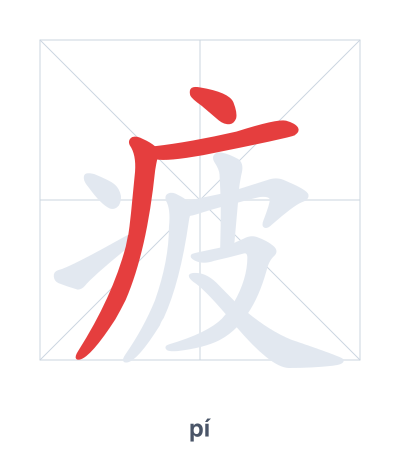
Open Hanzi Writer to see the animated stroke order and practice writing 疲 with real-time feedback.
The character 疲 (pí) is written with 10 strokes. Follow the standard Chinese stroke order: top to bottom, left to right, outside before inside. The radical 疒 is one of its key components.
Practice the correct stroke order with the Hanzi Writer app to see animated stroke-by-stroke guidance with real-time feedback.
疲 means tired.
As an HSK Level 7 character, 疲 is an intermediate-level character.
This character combines the sickness radical 疒 with 皮 (skin, pronounced pí). The skin represents the body's outer surface, suggesting exhaustion that permeates the whole body like an illness, while 皮 also provides the sound pí.
💡 Memory Tip: Picture your skin (皮) so saggy and limp from exhaustion that you need the sickness radical (疒) to show you're completely worn out.
工作一天后很疲劳。
gōng zuò yī tiān hòu hěn pí láo
One feels very tired after working for a day.
他的眼神显得很疲惫。
tā de yǎn shén xiǎn de hěn pí bèi
His gaze looks very tired.
走了很久,我感到疲倦。
zǒu le hěn jiǔ wǒ gǎn dào pí juàn
I feel tired after walking for a long time.
Open Hanzi Writer to see the animated stroke order and practice writing 疲 with real-time feedback.
✨ Animated stroke order · Handwriting recognition · HSK-graded practice · Free to use
疲 has the radical 疒 (illness) on the outside, which shows it relates to sickness or discomfort. Inside is 皮 (pí, skin), hinting that tiredness often affects the body's outer surface. Together, they suggest a state of physical exhaustion, like being "sick" from overwork.