掏 (tāo) means "to fish out or dig out" in Chinese. It has 11 strokes with the radical 扌, and is HSK Level 6.
Rated 4.2/5 in difficulty (advanced).
Harder than 64% of HSK Level 6 characters.
Appears in 3+ common words including 掏钱 (tāo qián), 掏出 (tāo chū), 掏空 (tāo kōng).
Due to its 11 strokes, Hanzi Writer's error detection shows 掏 requires focused practice — most learners need 10+ attempts for consistent accuracy.
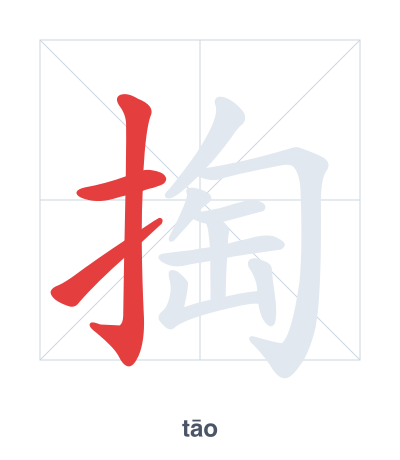
Open Hanzi Writer to see the animated stroke order and practice writing 掏 with real-time feedback.
The character 掏 (tāo) is written with 11 strokes. Follow the standard Chinese stroke order: top to bottom, left to right, outside before inside. The radical 扌 is one of its key components.
Practice the correct stroke order with the Hanzi Writer app to see animated stroke-by-stroke guidance with real-time feedback.
掏 means to fish out or dig out.
As an HSK Level 6 character, 掏 is an intermediate-level character.
掏 is a phono-semantic compound character. The left side 扌 (hand) indicates the action of using one's hand, while the right side 匋 (táo) provides the pronunciation and originally meant 'pottery'—hinting at reaching into a container. Together, they depict a hand reaching into a vessel to dig or fish something out.
💡 Memory Tip: Imagine a hand (扌) reaching deep into a clay pot (匋) to fish out a hidden treasure.
他从口袋里掏钱。
tā cóng kǒu dài lǐ tāo qián
He took money out of his pocket.
我掏出了手机。
wǒ tāo chū le shǒu jī
I pulled out my phone.
他的钱包被掏空了。
tā de qián bāo bèi tāo kōng le
His wallet was emptied.
Open Hanzi Writer to see the animated stroke order and practice writing 掏 with real-time feedback.
✨ Animated stroke order · Handwriting recognition · HSK-graded practice · Free to use
The left side is the radical 扌, meaning hand, which tells you the action involves the hand. The right side 匋 gives a phonetic clue and also suggests hollowing or digging, so together 掏 means to fish out or dig out something using your hand.