出 (chū) means "To go out; to exit; to produce" in Chinese. It has 5 strokes with the radical 凵, and is HSK Level 1.
Rated 2.2/5 in difficulty (moderate).
Harder than 22% of HSK Level 1 characters.
Appears in 3+ common words including 出去 (chū qù), 出口 (chū kǒu), 出发 (chū fā).
Hanzi Writer's stroke validation shows learners typically need 5-8 attempts to write 出 with correct proportion and order.
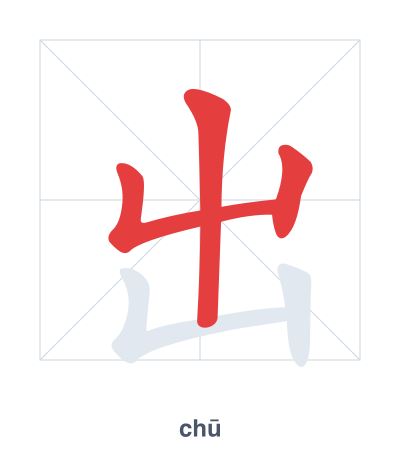
Open Hanzi Writer to see the animated stroke order and practice writing 出 with real-time feedback.
The character 出 (chū) is written with 5 strokes. Follow the standard Chinese stroke order: top to bottom, left to right, outside before inside. The radical 凵 is one of its key components.
Practice the correct stroke order with the Hanzi Writer app to see animated stroke-by-stroke guidance with real-time feedback.
出 means To go out; to exit; to produce.
As an HSK Level 1 character, 出 is among the first characters beginners learn.
The character 出 combines a foot (止) above a pit or opening (凵), depicting the action of stepping out from a dwelling. In ancient oracle bone script, it showed a foot leaving a cave, visually representing the idea of 'going out' or 'exiting'.
💡 Memory Tip: Imagine a foot (止) stepping out of a deep hole (凵) to go outside.
我们出去玩吧。
wǒ men chū qù wán ba
Let's go out and have fun.
出口在左边。
chū kǒu zài zuǒ biān
The exit is on the left.
我们明天出发。
wǒ men míng tiān chū fā
We are leaving tomorrow.
Open Hanzi Writer to see the animated stroke order and practice writing 出 with real-time feedback.
✨ Animated stroke order · Handwriting recognition · HSK-graded practice · Free to use
出 is made up of two mountain-like shapes (山) stacked vertically. This double-mountain structure suggests moving from one place to another, like climbing over two mountains to go out. The bottom part uses the radical 凵 (a container), hinting at exiting from an enclosed space.