糖 (táng) means "Sugar" in Chinese. It has 16 strokes with the radical 米, and is HSK Level 3.
Rated 4.2/5 in difficulty (advanced).
Harder than 89% of HSK Level 3 characters.
Appears in 3+ common words including 糖果 (táng guǒ), 白糖 (bái táng), 口香糖 (kǒu xiāng táng).
Due to its 16 strokes, Hanzi Writer's error detection shows 糖 requires focused practice — most learners need 10+ attempts for consistent accuracy.
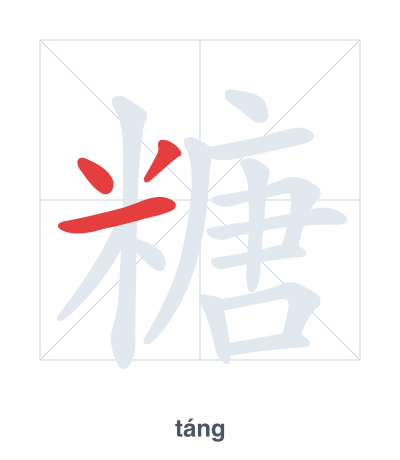
Open Hanzi Writer to see the animated stroke order and practice writing 糖 with real-time feedback.
The character 糖 (táng) is written with 16 strokes. Follow the standard Chinese stroke order: top to bottom, left to right, outside before inside. The radical 米 is one of its key components.
Practice the correct stroke order with the Hanzi Writer app to see animated stroke-by-stroke guidance with real-time feedback.
糖 means Sugar.
As an HSK Level 3 character, 糖 is an intermediate-level character.
糖 combines the radical 米 (rice), indicating its origin from grain starches, with the phonetic component 唐 (táng) for pronunciation. Ancient sugar was commonly made from malted rice, so the character visually links the material (rice) to the sound of the word.
💡 Memory Tip: Imagine a Tang dynasty chef pouring sweet rice (米) syrup into a sugar mold shaped like the character 唐.
孩子喜欢糖果。
hái zi xǐ huān táng guǒ
Children like candy.
咖啡里加点白糖。
kā fēi lǐ jiā diǎn bái táng
Add some white sugar to the coffee.
别乱扔口香糖。
bié luàn rēng kǒu xiāng táng
Don't litter chewing gum.
Open Hanzi Writer to see the animated stroke order and practice writing 糖 with real-time feedback.
✨ Animated stroke order · Handwriting recognition · HSK-graded practice · Free to use
糖 is composed of the radical 米 (rice) on the left and the phonetic component 唐 (táng) on the right. Rice (米) is a source of starch used to make sugar, so the radical hints at the material. The right side 唐 gives the pronunciation "táng" and also carried an ancient meaning of "sweet" in some contexts.