踏 (tā/tà) means "to step on; to tread" in Chinese. It has 15 strokes with the radical 足, and is HSK Level 6.
Rated 4.2/5 in difficulty (advanced).
Harder than 93% of HSK Level 6 characters.
Appears in 3+ common words including 踏步 (tà bù), 脚踏实地 (jiǎo tà shí dì), 踏实 (tā shí).
Due to its 15 strokes, Hanzi Writer's error detection shows 踏 requires focused practice — most learners need 10+ attempts for consistent accuracy.
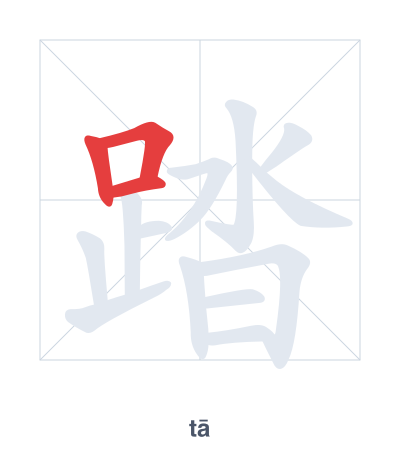
Open Hanzi Writer to see the animated stroke order and practice writing 踏 with real-time feedback.
The character 踏 (tā/tà) is written with 15 strokes. Follow the standard Chinese stroke order: top to bottom, left to right, outside before inside. The radical 足 is one of its key components.
Practice the correct stroke order with the Hanzi Writer app to see animated stroke-by-stroke guidance with real-time feedback.
踏 means to step on; to tread.
This is a polyphonic character with readings: tā, tà.
As an HSK Level 6 character, 踏 is an intermediate-level character.
踏 combines the foot radical 足 (foot) with 沓 (tà, meaning 'repeated' or 'to pile up'), which also provides the sound. The foot indicates the action of stepping, while 沓 suggests repeatedly treading or stamping on something.
💡 Memory Tip: Imagine a foot (足) stomping repeatedly into a puddle of water (the 水 in 沓) under the hot sun (曰/日), making a splashing sound with each step.
随着体育委员的口令,同学们开始原地踏步。
suí zhe tǐ yù wěi yuán de kǒu lìng tóng xué men kāi shǐ yuán dì tà bù
Following the sports monitor's command, the students began to march in place.
学习一定要脚踏实地,千万不能投机取巧。
xué xí yí dìng yào jiǎo tà shí dì qiān wàn bù néng tóu jī qǔ qiǎo
Learning must be down-to-earth; you must never try to take shortcuts.
只有把工作交给他做,经理心里才感到踏实。
zhǐ yǒu bǎ gōng zuò jiāo gěi tā zuò jīng lǐ xīn lǐ cái gǎn dào tā shí
The manager only feels at ease when the work is assigned to him.
Open Hanzi Writer to see the animated stroke order and practice writing 踏 with real-time feedback.
✨ Animated stroke order · Handwriting recognition · HSK-graded practice · Free to use
踏 is composed of the radical 足 (foot) on the left, which shows the meaning relates to foot actions, and the phonetic component 沓 (tà) on the right. Together, they create the idea of placing your foot down repeatedly, which matches the meaning "to step on" or "to tread."