跟 (gēn) means "with / to follow" in Chinese. It has 13 strokes with the radical 足, and is HSK Level 1.
Rated 3.7/5 in difficulty (challenging).
Harder than 98% of HSK Level 1 characters.
Appears in 3+ common words including 跟我 (gēn wǒ), 跟随 (gēn suí), 鞋跟 (xié gēn).
Due to its 13 strokes, Hanzi Writer's error detection shows 跟 requires focused practice — most learners need 10+ attempts for consistent accuracy.
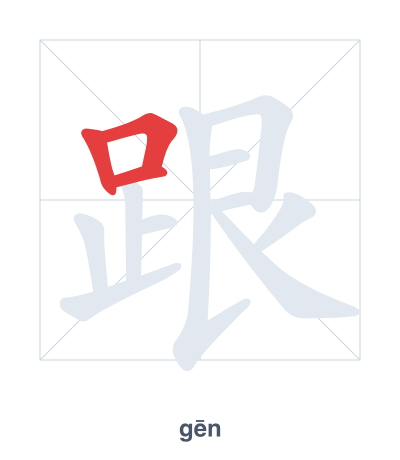
Open Hanzi Writer to see the animated stroke order and practice writing 跟 with real-time feedback.
The character 跟 (gēn) is written with 13 strokes. Follow the standard Chinese stroke order: top to bottom, left to right, outside before inside. The radical 足 is one of its key components.
Practice the correct stroke order with the Hanzi Writer app to see animated stroke-by-stroke guidance with real-time feedback.
跟 means with / to follow.
As an HSK Level 1 character, 跟 is among the first characters beginners learn.
跟 is a compound character with the radical 足 (foot) and the phonetic component 艮 (gèn). The core meaning is 'heel' (the back of the foot), which naturally extended to 'to follow'—as the heel follows the rest of the foot. The 足 radical visually anchors the idea of the foot, while 艮 provides pronunciation and originally depicted a person turning backward, reinforcing the sense of following behind.
💡 Memory Tip: Imagine a foot (足) pressing down on someone's heel (艮 shaped like a heel) to stay close and follow them.
请跟我来。
qǐng gēn wǒ lái
Please follow me.
他跟随老师学习。
tā gēn suí lǎo shī xué xí
He follows the teacher to learn.
这双鞋跟很高。
zhè shuāng xié gēn hěn gāo
The heels of these shoes are very high.
Open Hanzi Writer to see the animated stroke order and practice writing 跟 with real-time feedback.
✨ Animated stroke order · Handwriting recognition · HSK-graded practice · Free to use
The character 跟 is made of two parts: the left side 足 (foot) and the right side 艮 (gèn, which gives the sound). The foot radical shows that the meaning is related to foot actions, like following or going with someone.