跣 (xiǎn) means "barefoot" in Chinese. It has 13 strokes with the radical 足.
Rated 4.2/5 in difficulty (advanced).
Appears in 3+ common words including 跣足 (xiǎn zú), 跣行 (xiǎn xíng), 跣露 (xiǎn lù).
Due to its 13 strokes, Hanzi Writer's error detection shows 跣 requires focused practice — most learners need 10+ attempts for consistent accuracy.
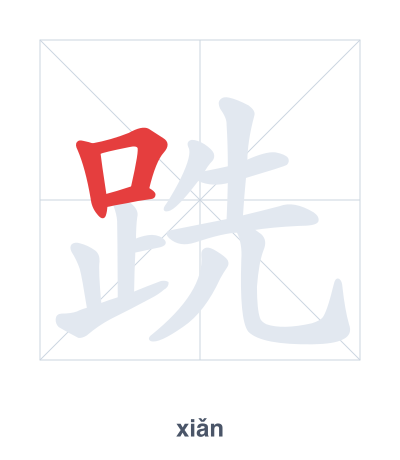
Open Hanzi Writer to see the animated stroke order and practice writing 跣 with real-time feedback.
The character 跣 (xiǎn) is written with 13 strokes. Follow the standard Chinese stroke order: top to bottom, left to right, outside before inside. The radical 足 is one of its key components.
Practice the correct stroke order with the Hanzi Writer app to see animated stroke-by-stroke guidance with real-time feedback.
跣 means barefoot.
跣 combines the radical 足 (foot) with 先 (first/before), suggesting feet that come first—barefoot, without any covering. In ancient China, stepping forward first with an unprotected foot signified being barefoot.
💡 Memory Tip: Picture the foot (足) going 'first' (先) onto a spiky floor, making you jump and feel the pain of being barefoot.
他跣足走在地上。
tā xiǎn zú zǒu zài dì shàng
He walked barefoot on the ground.
他在草地上跣行。
tā zài cǎo dì shàng xiǎn xíng
He is walking barefoot on the grass.
孩子跣露着双脚。
hái zi xiǎn lù zhe shuāng jiǎo
The child's feet are bare.
Open Hanzi Writer to see the animated stroke order and practice writing 跣 with real-time feedback.
✨ Animated stroke order · Handwriting recognition · HSK-graded practice · Free to use
跣 is a left-right character. The left side is the radical 足 (foot), which gives the meaning related to feet. The right side is 先 (xiān), which provides the sound pronunciation. Together, the character conveys the idea of being barefoot, as the foot is exposed.