步 (bù) means "Step / Pace" in Chinese. It has 7 strokes with the radical 止, and is HSK Level 3.
Rated 3.5/5 in difficulty (challenging).
Harder than 43% of HSK Level 3 characters.
Appears in 3+ common words including 跑步 (pǎo bù), 散步 (sàn bù), 进步 (jìn bù).
Due to its 7 strokes, Hanzi Writer's error detection shows 步 requires focused practice — most learners need 10+ attempts for consistent accuracy.
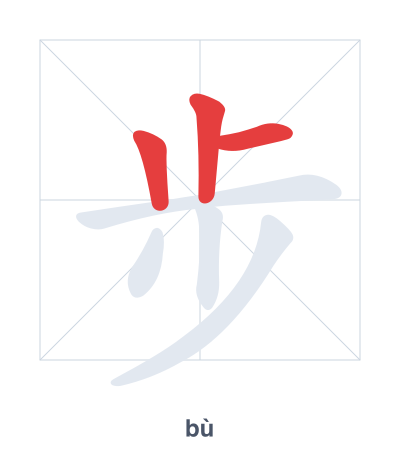
Open Hanzi Writer to see the animated stroke order and practice writing 步 with real-time feedback.
The character 步 (bù) is written with 7 strokes. Follow the standard Chinese stroke order: top to bottom, left to right, outside before inside. The radical 止 is one of its key components.
Practice the correct stroke order with the Hanzi Writer app to see animated stroke-by-stroke guidance with real-time feedback.
步 means Step / Pace.
As an HSK Level 3 character, 步 is an intermediate-level character.
步 shows two feet (止) arranged in sequence, representing the act of taking steps. Its ancient form in oracle bone script depicted two footprints following one another, symbolizing walking or pacing forward.
💡 Memory Tip: Picture two footprints (止) stacked one above the other, like a person taking one step up with the left foot, then the right foot following.
我每天早上跑步。
wǒ měi tiān zǎo shàng pǎo bù
I go running every morning.
我们去公园散步吧。
wǒ men qù gōng yuán sàn bù ba
Let's go for a walk in the park.
你的汉语进步很大。
nǐ de hàn yǔ jìn bù hěn dà
Your Chinese has improved a lot.
Open Hanzi Writer to see the animated stroke order and practice writing 步 with real-time feedback.
✨ Animated stroke order · Handwriting recognition · HSK-graded practice · Free to use
The character 步 is composed of the radical 止 (foot) on top and a modified 少 (meaning 'few' but originally a footprint) below. Together, they represent two feet moving forward, which conveys the idea of taking a step or pacing.