宿 (sù/xiǔ/xiù) means "To stay overnight / Lodge" in Chinese. It has 11 strokes with the radical 宀, and is HSK Level 5.
Rated 4.2/5 in difficulty (advanced).
Harder than 63% of HSK Level 5 characters.
Appears in 5+ common words including 宿舍 (sù shè), 住宿 (zhù sù), 一宿 (yī xiǔ).
Due to its 11 strokes, Hanzi Writer's error detection shows 宿 requires focused practice — most learners need 10+ attempts for consistent accuracy.
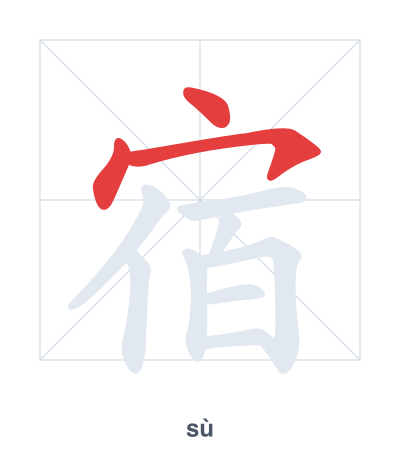
Open Hanzi Writer to see the animated stroke order and practice writing 宿 with real-time feedback.
The character 宿 (sù/xiǔ/xiù) is written with 11 strokes. Follow the standard Chinese stroke order: top to bottom, left to right, outside before inside. The radical 宀 is one of its key components.
Practice the correct stroke order with the Hanzi Writer app to see animated stroke-by-stroke guidance with real-time feedback.
宿 means To stay overnight / Lodge.
This is a polyphonic character with readings: sù, xiǔ, xiù.
As an HSK Level 5 character, 宿 is an intermediate-level character.
The character 宿 combines a roof (宀) with a person (亻) and a mat-like element (originally a sleeping mat, now resembling 百). Ancient forms showed a person lying on a mat under a roof, capturing the idea of staying overnight.
💡 Memory Tip: Imagine a person (亻) under a roof (宀) curling up on a mat (百) to spend the night.
学校为远道而来的新生安排了宿舍。
xué xiào wèi yuǎn dào ér lái de xīn shēng ān pái le sù shè
The school arranged dormitories for the new students who came from afar.
旅游高峰期间,这里的住宿非常紧张。
lǚ yóu gāo fēng qī jiān zhè lǐ de zhù sù fēi cháng jǐn zhāng
During the peak tourist season, accommodation here is very limited.
他因为赶进度,昨晚一宿都没有睡觉。
tā yīn wèi gǎn jìn dù zuó wǎn yī xiǔ dōu méi yǒu shuì jiào
He didn't sleep all night because he was rushing to meet a deadline.
这本书太精彩了,他半宿就看完了。
zhè běn shū tài jīng cǎi le tā bàn xiǔ jiù kàn wán le
This book is so wonderful that he finished reading it in just half a night.
Open Hanzi Writer to see the animated stroke order and practice writing 宿 with real-time feedback.
✨ Animated stroke order · Handwriting recognition · HSK-graded practice · Free to use
宿 has two main components: the roof radical 宀 on top, and 佰 (a phonetic component derived from 百) below. The roof radical suggests a building or shelter, while the lower part originally indicated a hundred people, collectively implying a place where many people stay overnight. So the structure visually combines a roof with many people to convey lodging.