星 (xīng) means "Star" in Chinese. It has 9 strokes with the radical 日, and is HSK Level 1.
Rated 3.5/5 in difficulty (challenging).
Harder than 79% of HSK Level 1 characters.
Appears in 3+ common words including 星期 (xīng qī), 星星 (xīng xīng), 明星 (míng xīng).
Due to its 9 strokes, Hanzi Writer's error detection shows 星 requires focused practice — most learners need 10+ attempts for consistent accuracy.
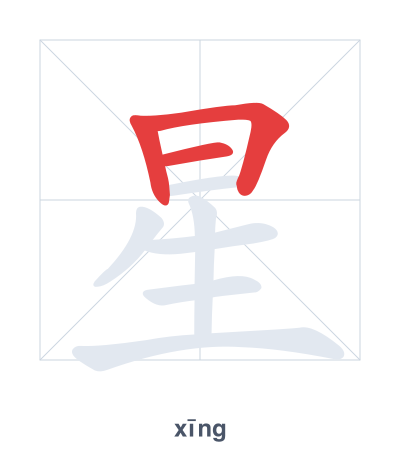
Open Hanzi Writer to see the animated stroke order and practice writing 星 with real-time feedback.
The character 星 (xīng) is written with 9 strokes. Follow the standard Chinese stroke order: top to bottom, left to right, outside before inside. The radical 日 is one of its key components.
Practice the correct stroke order with the Hanzi Writer app to see animated stroke-by-stroke guidance with real-time feedback.
星 means Star.
As an HSK Level 1 character, 星 is among the first characters beginners learn.
The character 星 (xīng) for 'star' is a compound of 日 (sun) above 生 (to give birth), suggesting that stars are born from the sun. In ancient forms, a cluster of three dots (stars) was placed above a pictograph of a plant (生) to indicate twinkling celestial bodies, later evolving into the modern structure with 日.
💡 Memory Tip: Picture the sun (日) giving birth (生) to a bright star that shoots out into the night sky.
今天是星期一。
jīn tiān shì xīng qī yī
Today is Monday.
天上有许多星星。
tiān shàng yǒu xǔ duō xīng xīng
There are many stars in the sky.
他是一个电影明星。
tā shì yí gè diàn yǐng míng xīng
He is a movie star.
Open Hanzi Writer to see the animated stroke order and practice writing 星 with real-time feedback.
✨ Animated stroke order · Handwriting recognition · HSK-graded practice · Free to use
The character 星 is made of two parts: 日 (sun) on top and 生 (to give birth) below. Together, they suggest the idea of a star being 'born' from the sun's light, or a shining object like the sun. This structure helps explain why 星 means 'star'.