住 (zhù) means "to live; to stay; to stop" in Chinese. It has 7 strokes with the radical 亻, and is HSK Level 1.
Rated 2.7/5 in difficulty (moderate).
Harder than 37% of HSK Level 1 characters.
Appears in 3+ common words including 住在 (zhù zài), 记住 (jì zhù), 住院 (zhù yuàn).
Hanzi Writer's stroke validation shows learners typically need 5-8 attempts to write 住 with correct proportion and order.
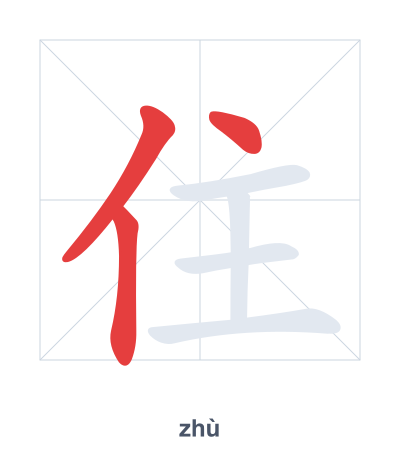
Open Hanzi Writer to see the animated stroke order and practice writing 住 with real-time feedback.
The character 住 (zhù) is written with 7 strokes. Follow the standard Chinese stroke order: top to bottom, left to right, outside before inside. The radical 亻 is one of its key components.
Practice the correct stroke order with the Hanzi Writer app to see animated stroke-by-stroke guidance with real-time feedback.
住 means to live; to stay; to stop.
As an HSK Level 1 character, 住 is among the first characters beginners learn.
The character 住 combines the person radical 亻 with 主 (master), suggesting a person who is the master of a place, meaning to live or stay. The component 主 also provides the pronunciation.
💡 Memory Tip: Picture a person (亻) planting a flag with a dot (主) on a plot of land to claim it as their home where they will live and stay.
我住在北京。
wǒ zhù zài běi jīng
I live in Beijing.
请记住我的名字。
qǐng jì zhù wǒ de míng zì
Please remember my name.
他生病住院了。
tā shēng bìng zhù yuàn le
He was sick and hospitalized.
Open Hanzi Writer to see the animated stroke order and practice writing 住 with real-time feedback.
✨ Animated stroke order · Handwriting recognition · HSK-graded practice · Free to use
住 is composed of the radical 亻 (person) on the left and 主 (main or host) on the right. The person radical connects to people, while 主 suggests a main place or host, together meaning 'to live' or 'to stay' at a location. This structure reflects the idea of a person residing at a primary place.