舍 (shě/shè) means "To give up; house" in Chinese. It has 8 strokes with the radical 舌, and is HSK Level 5.
Rated 3.7/5 in difficulty (challenging).
Harder than 39% of HSK Level 5 characters.
Appears in 4+ common words including 舍弃 (shě qì), 舍得 (shě de), 宿舍 (sù shè).
Due to its 8 strokes, Hanzi Writer's error detection shows 舍 requires focused practice — most learners need 10+ attempts for consistent accuracy.
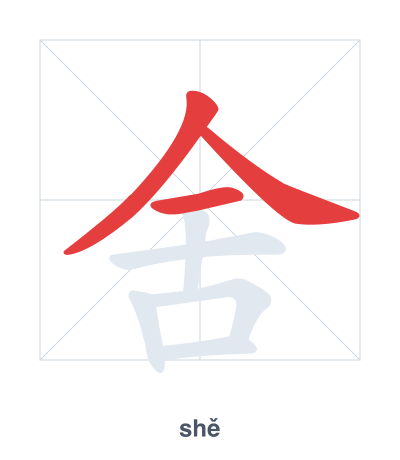
Open Hanzi Writer to see the animated stroke order and practice writing 舍 with real-time feedback.
The character 舍 (shě/shè) is written with 8 strokes. Follow the standard Chinese stroke order: top to bottom, left to right, outside before inside. The radical 舌 is one of its key components.
Practice the correct stroke order with the Hanzi Writer app to see animated stroke-by-stroke guidance with real-time feedback.
舍 means To give up; house.
This is a polyphonic character with readings: shě, shè.
As an HSK Level 5 character, 舍 is an intermediate-level character.
舍 combines a roof (亼) with the phonetic component 舌 (tongue), originally depicting a house or inn, and later extended to mean 'to give up' as in abandoning one's home.
💡 Memory Tip: Picture a person (人) under a roof giving up and sticking out their tongue (舌) in defeat.
为了大局,他不得不舍弃了个人的休息。
wèi le dà jú tā bù dé bù shě qì le gè rén de xiū xī
For the sake of the big picture, he had to give up his personal rest.
他非常慷慨,舍得把好东西分享给朋友。
tā fēi cháng kāng kǎi shě de bǎ hǎo dōng xī fēn xiǎng gěi péng yǒu
He is very generous and willing to share good things with his friends.
学校的宿舍里住着来自全国各地的学生。
xué xiào de sù shè lǐ zhù zhe lái zì quán guó gè dì de xué shēng
Students from all over the country live in the school dormitories.
经过修缮后的校舍变得既明亮又宽敞。
jīng guò xiū shàn hòu de xiào shè biàn dé jì míng liàng yòu kuān chǎng
After renovation, the school building became both bright and spacious.
Open Hanzi Writer to see the animated stroke order and practice writing 舍 with real-time feedback.
✨ Animated stroke order · Handwriting recognition · HSK-graded practice · Free to use
舍 combines the radical 舌 (tongue) on top and a bottom component that originally represented a roof or house shape. The idea is that words from the tongue (舌) can decide to let go or abandon something (give up), while the roof part gives the meaning of a house (shè). So 舍 has two related meanings: 'to give up' and 'house.'