完 (wán) means "Finish / Complete" in Chinese. It has 7 strokes with the radical 宀, and is HSK Level 2.
Rated 2.9/5 in difficulty (moderate).
Harder than 37% of HSK Level 2 characters.
Appears in 3+ common words including 完成 (wán chéng), 吃完 (chī wán), 完美 (wán měi).
Hanzi Writer's stroke validation shows learners typically need 5-8 attempts to write 完 with correct proportion and order.
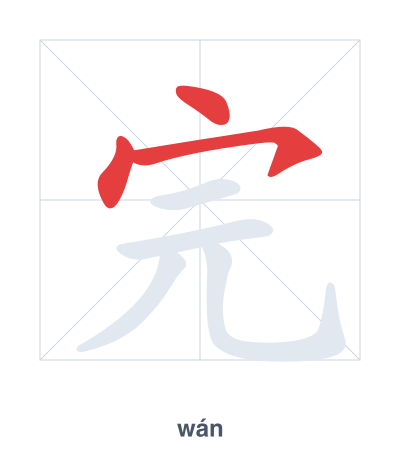
Open Hanzi Writer to see the animated stroke order and practice writing 完 with real-time feedback.
The character 完 (wán) is written with 7 strokes. Follow the standard Chinese stroke order: top to bottom, left to right, outside before inside. The radical 宀 is one of its key components.
Practice the correct stroke order with the Hanzi Writer app to see animated stroke-by-stroke guidance with real-time feedback.
完 means Finish / Complete.
As an HSK Level 2 character, 完 is among the first characters beginners learn.
完 combines the roof radical 宀 with 元 ('origin' or 'head'), suggesting that something is finished when it reaches its original state or is fully covered under a roof.
💡 Memory Tip: Picture a roof (宀) sheltering a perfect 'yuan' coin (元) to mark the completion of your savings goal.
我完成了作业。
wǒ wán chéng le zuò yè
I finished my homework.
我吃完饭了。
wǒ chī wán fàn le
I've finished my meal.
这个计划很完美。
zhè ge jì huà hěn wán měi
This plan is perfect.
Open Hanzi Writer to see the animated stroke order and practice writing 完 with real-time feedback.
✨ Animated stroke order · Handwriting recognition · HSK-graded practice · Free to use
完 is made of two parts: the radical 宀 (roof) on top and the character 元 (first/original) below. The roof represents a house or shelter, and 元 suggests something that is original or whole. Together, they imply that under a roof, things are kept complete and finished.