客 (kè) means "Guest; visitor; customer." in Chinese. It has 9 strokes with the radical 宀, and is HSK Level 1.
Rated 3.5/5 in difficulty (challenging).
Harder than 77% of HSK Level 1 characters.
Appears in 3+ common words including 客人 (kè rén), 客气 (kè qì), 客厅 (kè tīng).
Due to its 9 strokes, Hanzi Writer's error detection shows 客 requires focused practice — most learners need 10+ attempts for consistent accuracy.
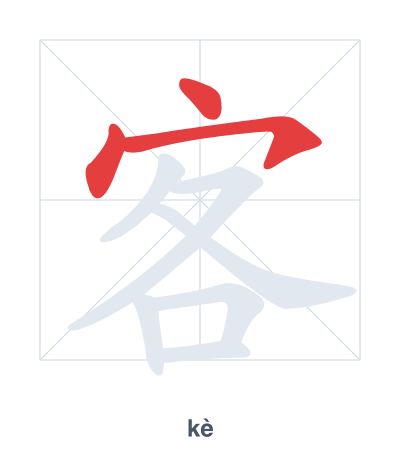
Open Hanzi Writer to see the animated stroke order and practice writing 客 with real-time feedback.
The character 客 (kè) is written with 9 strokes. Follow the standard Chinese stroke order: top to bottom, left to right, outside before inside. The radical 宀 is one of its key components.
Practice the correct stroke order with the Hanzi Writer app to see animated stroke-by-stroke guidance with real-time feedback.
客 means Guest; visitor; customer..
As an HSK Level 1 character, 客 is among the first characters beginners learn.
客 combines the roof radical 宀 (mián, shelter) with 各 (gè), which in ancient script showed a foot (夂) arriving at a dwelling. Together, they depict a person who comes to rest under a roof—a guest or visitor.
💡 Memory Tip: Imagine a guest under your roof (宀); each time you open the door, you say '各' (each one) is a new visitor.
家里来了客人。
jiā lǐ lái le kè rén
Guests have arrived at the house.
别客气,请坐。
bié kè qì qǐng zuò
Please don't stand on ceremony; have a seat.
客厅里有一台电视。
kè tīng lǐ yǒu yī tái diàn shì
There is a TV in the living room.
Open Hanzi Writer to see the animated stroke order and practice writing 客 with real-time feedback.
✨ Animated stroke order · Handwriting recognition · HSK-graded practice · Free to use
The character 客 is made of two parts: the radical 宀 (roof) on top and 各 (each) on the bottom. The roof suggests a house or shelter, and 各 implies 'each person' — together they picture 'each person under a roof,' which relates to a guest or visitor who stays in someone's home.