诵 (sòng) means "to recite" in Chinese. It has 9 strokes with the radical 讠, and is HSK Level 7.
Rated 3.7/5 in difficulty (challenging).
Harder than 31% of HSK Level 7 characters.
Appears in 3+ common words including 背诵 (bèi sòng), 朗诵 (lǎng sòng), 诵读 (sòng dú).
Due to its 9 strokes, Hanzi Writer's error detection shows 诵 requires focused practice — most learners need 10+ attempts for consistent accuracy.
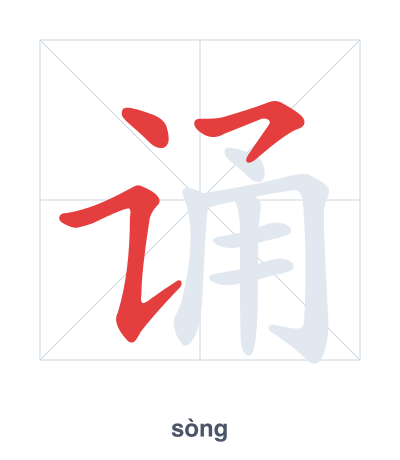
Open Hanzi Writer to see the animated stroke order and practice writing 诵 with real-time feedback.
The character 诵 (sòng) is written with 9 strokes. Follow the standard Chinese stroke order: top to bottom, left to right, outside before inside. The radical 讠 is one of its key components.
Practice the correct stroke order with the Hanzi Writer app to see animated stroke-by-stroke guidance with real-time feedback.
诵 means to recite.
As an HSK Level 7 character, 诵 is an intermediate-level character.
诵 is a phono-semantic compound. The radical 讠 (speech) indicates that the meaning relates to speaking or uttering. The component 甬 originally depicted a hanging bell or chime, suggesting a rhythmic, resonant sound, so together they evoke the idea of reciting aloud with a melodic or chanting tone.
💡 Memory Tip: Picture a speaker (讠) who recites poetry while pulling a bell rope (甬) to keep a rhythmic chime.
我会背诵这首诗。
wǒ huì bèi sòng zhè shǒu shī
I can recite this poem.
他在台上朗诵课文。
tā zài tái shàng lǎng sòng kè wén
He is reciting the text on the stage.
每天早上要诵读。
měi tiān zǎo shàng yào sòng dú
Recite aloud every morning.
Open Hanzi Writer to see the animated stroke order and practice writing 诵 with real-time feedback.
✨ Animated stroke order · Handwriting recognition · HSK-graded practice · Free to use
The left part 讠 is the speech radical, indicating that the character relates to speaking or language. The right part 甬 (yǒng) originally means a path or tunnel, suggesting a continuous flow, which together with speech gives the idea of reciting smoothly.