趋 (qū) means "To tend towards; to hurry." in Chinese. It has 12 strokes with the radical 走, and is HSK Level 4.
Rated 4.2/5 in difficulty (advanced).
Harder than 92% of HSK Level 4 characters.
Appears in 3+ common words including 趋势 (qū shì), 趋向 (qū xiàng), 趋于 (qū yú).
Due to its 12 strokes, Hanzi Writer's error detection shows 趋 requires focused practice — most learners need 10+ attempts for consistent accuracy.
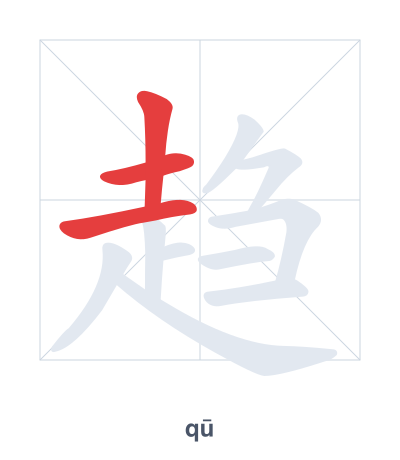
Open Hanzi Writer to see the animated stroke order and practice writing 趋 with real-time feedback.
The character 趋 (qū) is written with 12 strokes. Follow the standard Chinese stroke order: top to bottom, left to right, outside before inside. The radical 走 is one of its key components.
Practice the correct stroke order with the Hanzi Writer app to see animated stroke-by-stroke guidance with real-time feedback.
趋 means To tend towards; to hurry..
As an HSK Level 4 character, 趋 is an intermediate-level character.
趋 combines 走 (to walk) with 刍 (phonetic component, originally meaning cut grass or fodder), suggesting the swift movement of someone hurrying toward something, like an animal rushing to feed. The ancient form of 走 depicted a person with swinging arms, emphasizing brisk motion.
💡 Memory Tip: Imagine a person walking briskly (走) toward a pile of fresh-cut grass (刍), hurrying to grab it before anyone else.
这是一个趋势。
zhè shì yí gè qū shì
This is a trend.
趋向好转。
qū xiàng hǎo zhuǎn
Tending to improve.
趋于稳定。
qū yú wěn dìng
Tending towards stability.
Open Hanzi Writer to see the animated stroke order and practice writing 趋 with real-time feedback.
✨ Animated stroke order · Handwriting recognition · HSK-graded practice · Free to use
The character 趋 combines the radical 走 (to walk) on the left and a phonetic component 刍 (chú, meaning 'cut grass' but here indicating sound) on the right. Together, the walking radical suggests movement, which connects to the meanings 'to hurry' and 'to tend towards'—like walking quickly in a certain direction.