于 (yú) means "In, at, or to." in Chinese. It has 3 strokes with the radical 二, and is HSK Level 2.
Rated 1.7/5 in difficulty (beginner-friendly).
Harder than 2% of HSK Level 2 characters.
Appears in 3+ common words including 由于 (yóu yú), 关于 (guān yú), 等于 (děng yú).
In the Hanzi Writer app, most learners master 于 within 3 practice attempts using stroke-by-stroke animation.
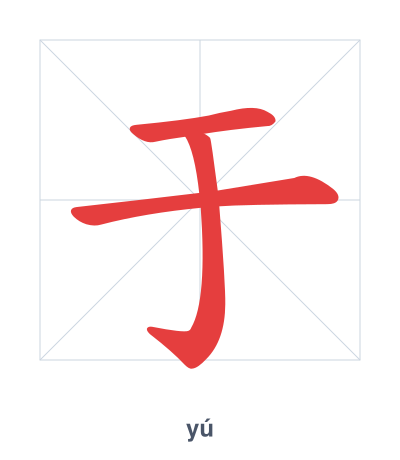
Open Hanzi Writer to see the animated stroke order and practice writing 于 with real-time feedback.
The character 于 (yú) is written with 3 strokes. Follow the standard Chinese stroke order: top to bottom, left to right, outside before inside. The radical 二 is one of its key components.
Practice the correct stroke order with the Hanzi Writer app to see animated stroke-by-stroke guidance with real-time feedback.
于 means In, at, or to..
As an HSK Level 2 character, 于 is among the first characters beginners learn.
于 originally depicted a curled breath or a puff of air rising upward, symbolizing movement or direction. Over time, it simplified into its current three-stroke form, where the top horizontal line represents a starting point and the lower hook indicates movement toward or through a location, giving it the sense of 'in,' 'at,' or 'to.'
💡 Memory Tip: Picture a tiny arrow (the vertical line with a hook) pointing from the top bar (a starting point) down to a specific spot — it means 'at' that location.
由于下雨,我不去了。
yóu yú xià yǔ wǒ bù qù le
Because of the rain, I'm not going.
关于这个问题,你怎么看?
guān yú zhè ge wèn tí nǐ zěn me kàn
What is your opinion on this issue?
一加一等于二。
yī jiā yī děng yú èr
One plus one equals two.
Open Hanzi Writer to see the animated stroke order and practice writing 于 with real-time feedback.
✨ Animated stroke order · Handwriting recognition · HSK-graded practice · Free to use
于 is made of two horizontal strokes (like the radical 二) with a vertical hook below. The two horizontals represent a base or marker, and the hook points downward or left, suggesting movement to a place. This shape visually supports its meaning as a preposition for location or direction, such as 'in', 'at', or 'to'.