向 (xiàng) means "towards; to; direction" in Chinese. It has 6 strokes with the radical 口, and is HSK Level 2.
Rated 2.7/5 in difficulty (moderate).
Harder than 27% of HSK Level 2 characters.
Appears in 3+ common words including 方向 (fāng xiàng), 向前 (xiàng qián), 向往 (xiàng wǎng).
Hanzi Writer's stroke validation shows learners typically need 5-8 attempts to write 向 with correct proportion and order.
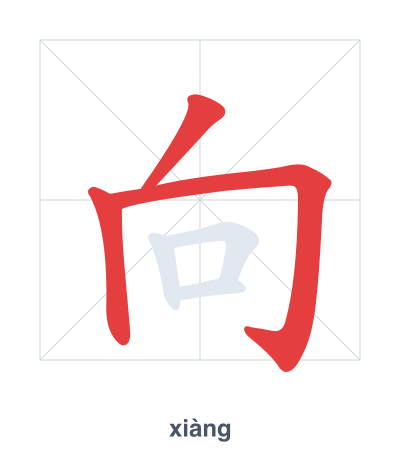
Open Hanzi Writer to see the animated stroke order and practice writing 向 with real-time feedback.
The character 向 (xiàng) is written with 6 strokes. Follow the standard Chinese stroke order: top to bottom, left to right, outside before inside. The radical 口 is one of its key components.
Practice the correct stroke order with the Hanzi Writer app to see animated stroke-by-stroke guidance with real-time feedback.
向 means towards; to; direction.
As an HSK Level 2 character, 向 is among the first characters beginners learn.
Originally a pictograph of a house with a window (口) on the north wall, indicating the direction the window faces. Over time it came to mean 'towards' or 'direction.'
💡 Memory Tip: Picture an arrow (丿) pointing straight towards a mouth (口) inside a building (冂), showing the way to go.
这里的方向很难找。
zhè lǐ de fāng xiàng hěn nán zhǎo
The directions here are hard to find.
请一直向前走。
qǐng yì zhí xiàng qián zǒu
Please go straight ahead.
我向往北京的生活。
wǒ xiàng wǎng běi jīng de shēng huó
I yearn for life in Beijing.
Open Hanzi Writer to see the animated stroke order and practice writing 向 with real-time feedback.
✨ Animated stroke order · Handwriting recognition · HSK-graded practice · Free to use
向 is made of a roof-like top (冖) over a mouth (口). This structure originally showed a window under a roof, which came to mean 'toward' or 'direction' because a window faces a certain way.