倾 (qīng) means "to lean; to tilt; to pour" in Chinese. It has 10 strokes with the radical 亻, and is HSK Level 6.
Rated 3.9/5 in difficulty (challenging).
Harder than 38% of HSK Level 6 characters.
Appears in 3+ common words including 倾向 (qīng xiàng), 倾听 (qīng tīng), 倾斜 (qīng xié).
Due to its 10 strokes, Hanzi Writer's error detection shows 倾 requires focused practice — most learners need 10+ attempts for consistent accuracy.
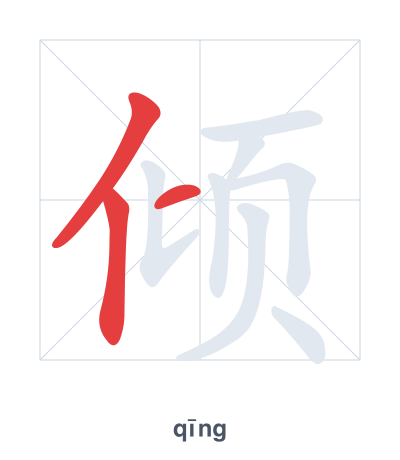
Open Hanzi Writer to see the animated stroke order and practice writing 倾 with real-time feedback.
The character 倾 (qīng) is written with 10 strokes. Follow the standard Chinese stroke order: top to bottom, left to right, outside before inside. The radical 亻 is one of its key components.
Practice the correct stroke order with the Hanzi Writer app to see animated stroke-by-stroke guidance with real-time feedback.
倾 means to lean; to tilt; to pour.
As an HSK Level 6 character, 倾 is an intermediate-level character.
The character 倾 is formed by the radical 亻 (person) and the component 顷, which originally depicted a person with a tilted head, meaning 'to incline'. Combined, it signifies a person leaning or tilting, and by extension, pouring liquid from a container.
💡 Memory Tip: Picture a person (亻) tilting their head (顷) as they pour a drink from a bottle.
我倾向于去北京。
wǒ qīng xiàng yú qù běi jīng
I am leaning towards going to Beijing.
请认真倾听。
qǐng rèn zhēn qīng tīng
Please listen carefully.
房子有点倾斜。
fáng zi yǒu diǎn qīng xié
The house is slightly tilted.
Open Hanzi Writer to see the animated stroke order and practice writing 倾 with real-time feedback.
✨ Animated stroke order · Handwriting recognition · HSK-graded practice · Free to use
倾 has the radical 亻 (person) on the left, showing this action is done by a person. The right side 顷 provides the pronunciation and contains 页 (head), which visually suggests a head tilting to one side, linking to the meaning 'to lean or tilt'.