斜 (xié) means "Slanting / Tilted" in Chinese. It has 11 strokes with the radical 斗, and is HSK Level 5.
Rated 4.2/5 in difficulty (advanced).
Harder than 74% of HSK Level 5 characters.
Appears in 3+ common words including 斜坡 (xié pō), 倾斜 (qīng xié), 斜边 (xié biān).
Due to its 11 strokes, Hanzi Writer's error detection shows 斜 requires focused practice — most learners need 10+ attempts for consistent accuracy.
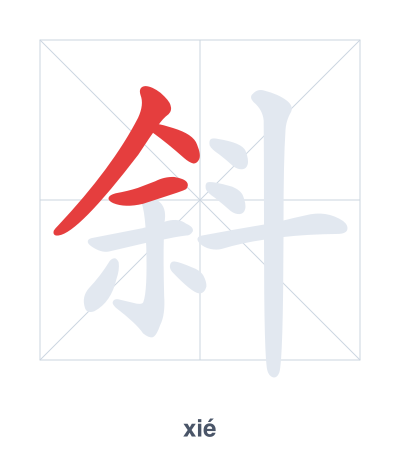
Open Hanzi Writer to see the animated stroke order and practice writing 斜 with real-time feedback.
The character 斜 (xié) is written with 11 strokes. Follow the standard Chinese stroke order: top to bottom, left to right, outside before inside. The radical 斗 is one of its key components.
Practice the correct stroke order with the Hanzi Writer app to see animated stroke-by-stroke guidance with real-time feedback.
斜 means Slanting / Tilted.
As an HSK Level 5 character, 斜 is an intermediate-level character.
斜 combines 余 (surplus) and 斗 (a measuring dipper). It originally depicted tilting a dipper to pour out excess grain, which created a slanting or tilted motion. The radical 斗 emphasizes the act of measuring while pouring.
💡 Memory Tip: Picture a person (余 as 'I' shaped like a leaner) tipping a dipper (斗) sideways so the leftovers spill out at an angle.
他在斜坡上走。
tā zài xié pō shàng zǒu
He is walking on the slope.
桌子有点倾斜。
zhuō zi yǒu diǎn qīng xié
The table is slightly tilted.
这条线是斜边。
zhè tiáo xiàn shì xié biān
This line is the hypotenuse.
Open Hanzi Writer to see the animated stroke order and practice writing 斜 with real-time feedback.
✨ Animated stroke order · Handwriting recognition · HSK-graded practice · Free to use
斜 is made of two parts: left side 余 (yú, surplus) and right side 斗 (dǒu, dipper). The dipper shape is often tilted when used, which visually suggests a slanted angle. The left part gives the sound, and together they form the idea of something leaning or not straight.