琴 (qín) means "Stringed musical instrument (e.g., piano, zither)" in Chinese. It has 12 strokes with the radical 王, and is HSK Level 5.
Rated 3.9/5 in difficulty (challenging).
Harder than 46% of HSK Level 5 characters.
Appears in 3+ common words including 钢琴 (gāng qín), 弹琴 (tán qín), 小提琴 (xiǎo tí qín).
Due to its 12 strokes, Hanzi Writer's error detection shows 琴 requires focused practice — most learners need 10+ attempts for consistent accuracy.
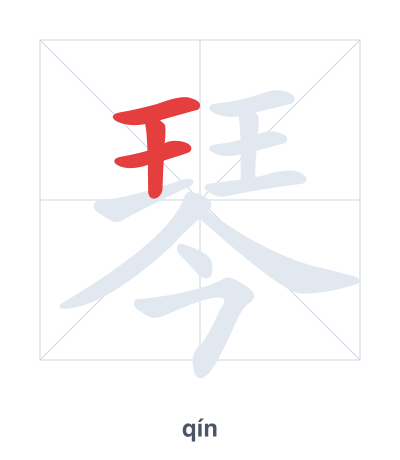
Open Hanzi Writer to see the animated stroke order and practice writing 琴 with real-time feedback.
The character 琴 (qín) is written with 12 strokes. Follow the standard Chinese stroke order: top to bottom, left to right, outside before inside. The radical 王 is one of its key components.
Practice the correct stroke order with the Hanzi Writer app to see animated stroke-by-stroke guidance with real-time feedback.
琴 means Stringed musical instrument (e.g., piano, zither).
As an HSK Level 5 character, 琴 is an intermediate-level character.
琴 is a compound character. The top part 玨 (two jade pieces) originally represented the strings or jade decorations of the instrument, while the bottom 今 provides phonetic guidance. Together, they depict a stringed musical instrument like the guqin or piano.
💡 Memory Tip: Two kings (王王) are now (今) playing a piano together—one for each hand!
我想学钢琴。
wǒ xiǎng xué gāng qín
I want to learn to play the piano.
他在房间弹琴。
tā zài fáng jiān tán qín
He is playing the zither in the room.
小提琴很好听。
xiǎo tí qín hěn hǎo tīng
The violin sounds beautiful.
Open Hanzi Writer to see the animated stroke order and practice writing 琴 with real-time feedback.
✨ Animated stroke order · Handwriting recognition · HSK-graded practice · Free to use
The character 琴 has two parts: the top is 珡 (two jade pieces) and the bottom is 今 (a phonetic hint). The jade pieces represent the elegant material used for ancient stringed instruments, while the sound comes from 今. Together they suggest a high-quality stringed instrument like a zither or piano.