提 (dī/tí) means "To carry, lift, or mention" in Chinese. It has 12 strokes with the radical 扌, and is HSK Level 2.
Rated 3.7/5 in difficulty (challenging).
Harder than 77% of HSK Level 2 characters.
Appears in 4+ common words including 提高 (tí gāo), 提醒 (tí xǐng), 提防 (dī fáng).
Due to its 12 strokes, Hanzi Writer's error detection shows 提 requires focused practice — most learners need 10+ attempts for consistent accuracy.
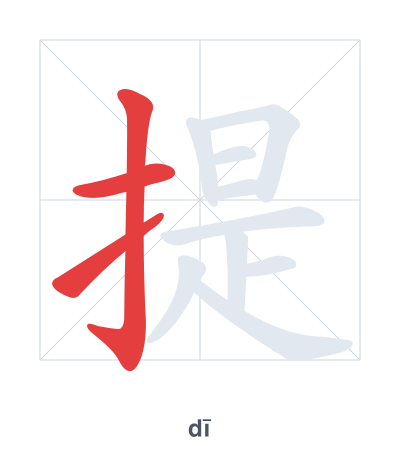
Open Hanzi Writer to see the animated stroke order and practice writing 提 with real-time feedback.
The character 提 (dī/tí) is written with 12 strokes. Follow the standard Chinese stroke order: top to bottom, left to right, outside before inside. The radical 扌 is one of its key components.
Practice the correct stroke order with the Hanzi Writer app to see animated stroke-by-stroke guidance with real-time feedback.
提 means To carry, lift, or mention.
This is a polyphonic character with readings: dī, tí.
As an HSK Level 2 character, 提 is among the first characters beginners learn.
提 combines the hand radical 扌 with the phonetic component 是, which originally depicted a sun over a foot meaning 'straight' or 'correct'. A hand lifting something straight upward conveys the action of carrying or lifting.
💡 Memory Tip: Your hand (扌) lifts the sun (日) above a foot (止) — that's how you carry something heavy.
只有不断学习,才能不断提高自己的水平。
zhǐ yǒu bù duàn xué xí cái néng bù duàn tí gāo zì jǐ de shuǐ píng
Only by continuous learning can you constantly improve your skills.
妈妈总是提醒我出门时要带上雨伞。
mā mā zǒng shì tí xǐng wǒ chū mén shí yào dài shàng yǔ sǎn
Mom always reminds me to take an umbrella when I go out.
在外旅行时,我们要提防陌生人的搭讪。
zài wài lǚ xíng shí wǒ men yào dī fáng mò shēng rén de dā shàn
When traveling, we should be wary of strangers trying to strike up a conversation.
爷爷手里提溜着一篮子新鲜的蔬菜。
yé yé shǒu lǐ dī liū zhe yī lán zi xīn xiān de shū cài
Grandpa is carrying a basket of fresh vegetables in his hand.
Open Hanzi Writer to see the animated stroke order and practice writing 提 with real-time feedback.
✨ Animated stroke order · Handwriting recognition · HSK-graded practice · Free to use
提 is made of the hand radical 扌 on the left and 是 (shì) on the right. The hand radical directly connects to the actions of carrying or lifting with your hand. The right side 是 provides a sound hint (tí) and also suggests 'correctness' – as in lifting something to the proper place.