王 (wáng) means "King / Surname Wang" in Chinese. It has 4 strokes with the radical 王, and is HSK Level 4.
Rated 2.4/5 in difficulty (moderate).
Harder than 4% of HSK Level 4 characters.
Appears in 3+ common words including 国王 (guó wáng), 王子 (wáng zǐ), 王先生 (wáng xiān shēng).
Hanzi Writer's stroke validation shows learners typically need 5-8 attempts to write 王 with correct proportion and order.
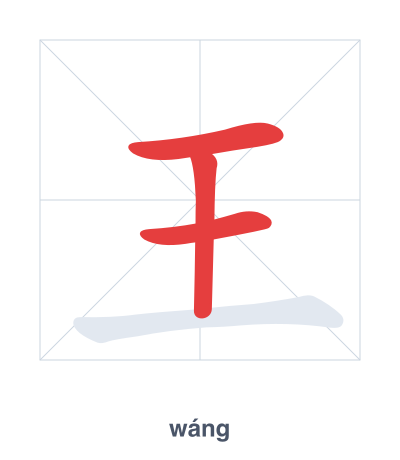
Open Hanzi Writer to see the animated stroke order and practice writing 王 with real-time feedback.
The character 王 (wáng) is written with 4 strokes. Follow the standard Chinese stroke order: top to bottom, left to right, outside before inside. The radical 王 is one of its key components.
Practice the correct stroke order with the Hanzi Writer app to see animated stroke-by-stroke guidance with real-time feedback.
王 means King / Surname Wang.
As an HSK Level 4 character, 王 is an intermediate-level character.
The character 王 originally depicted a large ceremonial axe, a symbol of royal authority and power. Over time, the axe's shape simplified into three horizontal strokes representing heaven, earth, and humanity, linked by a single vertical stroke signifying the king who unites them.
💡 Memory Tip: Picture the three horizontal lines as a crown's tiers, with the vertical line as the king's spine holding it all together.
国王住在宫殿里。
guó wáng zhù zài gōng diàn lǐ
The king lives in a palace.
王子骑着一匹白马。
wáng zǐ qí zhe yì pǐ bái mǎ
The prince is riding a white horse.
王先生是我的老师。
wáng xiān shēng shì wǒ de lǎo shī
Mr. Wang is my teacher.
Open Hanzi Writer to see the animated stroke order and practice writing 王 with real-time feedback.
✨ Animated stroke order · Handwriting recognition · HSK-graded practice · Free to use
The character 王 consists of three horizontal strokes connected by a vertical stroke. This shape was originally a picture of an axe, a symbol of royal power in ancient China. The three horizontal lines represent heaven, earth, and humanity, with the vertical line showing the king as the unifying force.