玑 (jī) means "irregular pearl" in Chinese. It has 6 strokes with the radical 王.
Rated 3.2/5 in difficulty (challenging).
Appears in 3+ common words including 珠玑 (zhū jī), 璇玑 (xuán jī), 玑子 (jī zi).
Due to its 6 strokes, Hanzi Writer's error detection shows 玑 requires focused practice — most learners need 10+ attempts for consistent accuracy.
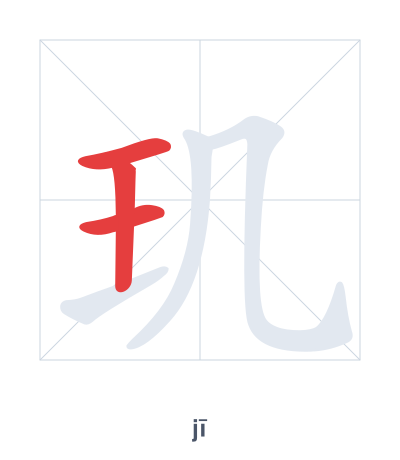
Open Hanzi Writer to see the animated stroke order and practice writing 玑 with real-time feedback.
The character 玑 (jī) is written with 6 strokes. Follow the standard Chinese stroke order: top to bottom, left to right, outside before inside. The radical 王 is one of its key components.
Practice the correct stroke order with the Hanzi Writer app to see animated stroke-by-stroke guidance with real-time feedback.
玑 means irregular pearl.
The character 玑 combines the radical 王 (jade, indicating a precious gem) with the phonetic component 几 (jī, meaning 'small table' or 'a few'). The jade radical points to a pearl or gem, while 几 hints at irregularity—like a pearl that is not perfectly round, perhaps with uneven surfaces.
💡 Memory Tip: Imagine a jade pearl (王) so irregularly shaped that it looks like a wobbly little table (几) that won't sit flat.
他的文章字字珠玑。
tā de wén zhāng zì zì zhū jī
Every word in his article is a gem.
璇玑是古代的仪器。
xuán jī shì gǔ dài de yí qì
Xuanji is an ancient instrument.
这串玑子很精致。
zhè chuàn jī zi hěn jīng zhì
This string of small pearls is very exquisite.
Open Hanzi Writer to see the animated stroke order and practice writing 玑 with real-time feedback.
✨ Animated stroke order · Handwriting recognition · HSK-graded practice · Free to use
玑 is composed of the radical 王 (jade) on the left, and the component 几 (jī) on the right, which provides the sound. The 王 radical connects the character to gems or precious stones, while 几 helps to indicate the pronunciation. Together, they form the meaning 'irregular pearl', a type of gemstone.