肺 (fèi) means "lung" in Chinese. It has 8 strokes with the radical ⺼, and is HSK Level 6.
Rated 3.7/5 in difficulty (challenging).
Harder than 34% of HSK Level 6 characters.
Appears in 3+ common words including 肺部 (fèi bù), 肺炎 (fèi yán), 肺活量 (fèi huó liàng).
Due to its 8 strokes, Hanzi Writer's error detection shows 肺 requires focused practice — most learners need 10+ attempts for consistent accuracy.
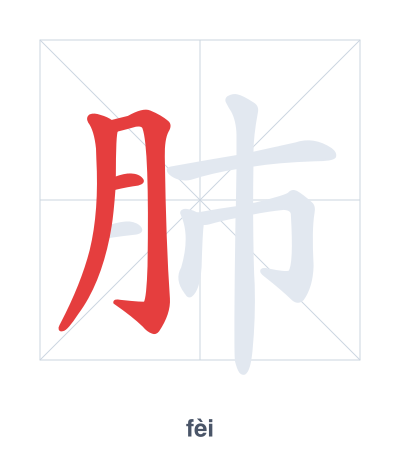
Open Hanzi Writer to see the animated stroke order and practice writing 肺 with real-time feedback.
The character 肺 (fèi) is written with 8 strokes. Follow the standard Chinese stroke order: top to bottom, left to right, outside before inside. The radical ⺼ is one of its key components.
Practice the correct stroke order with the Hanzi Writer app to see animated stroke-by-stroke guidance with real-time feedback.
肺 means lung.
As an HSK Level 6 character, 肺 is an intermediate-level character.
The character 肺 combines the meat radical ⺼ (flesh) with the phonetic component 巿 (fèi). The left side indicates it is a body organ, while the right side originally depicted a branching network, representing the lung's air passages.
💡 Memory Tip: Picture a fleshy lung (⺼) with a T-shaped windpipe (the right part) branching into two lobes.
抽烟对肺部不好。
chōu yān duì fèi bù bù hǎo
Smoking is bad for the lungs.
他最近得了肺炎。
tā zuì jìn dé le fèi yán
He recently got pneumonia.
运动员的肺活量很大。
yùn dòng yuán de fèi huó liàng hěn dà
Athletes have a large lung capacity.
Open Hanzi Writer to see the animated stroke order and practice writing 肺 with real-time feedback.
✨ Animated stroke order · Handwriting recognition · HSK-graded practice · Free to use
The left component is ⺼ (meat radical), which indicates the character relates to a body organ. The right component is 巿, which provides a phonetic clue to the pronunciation "fèi" and completes the character for "lung".