肥 (féi) means "Fat; fertile; fertilizer." in Chinese. It has 8 strokes with the radical ⺼, and is HSK Level 4.
Rated 3.7/5 in difficulty (challenging).
Harder than 49% of HSK Level 4 characters.
Appears in 3+ common words including 减肥 (jiǎn féi), 肥肉 (féi ròu), 肥皂 (féi zào).
Due to its 8 strokes, Hanzi Writer's error detection shows 肥 requires focused practice — most learners need 10+ attempts for consistent accuracy.
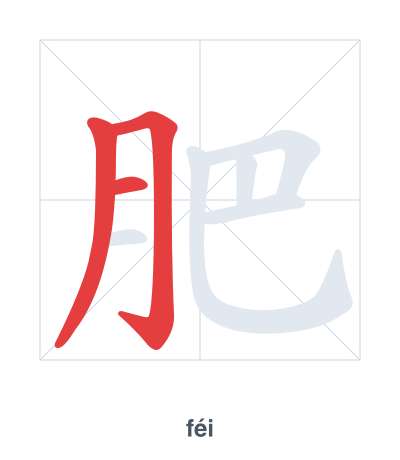
Open Hanzi Writer to see the animated stroke order and practice writing 肥 with real-time feedback.
The character 肥 (féi) is written with 8 strokes. Follow the standard Chinese stroke order: top to bottom, left to right, outside before inside. The radical ⺼ is one of its key components.
Practice the correct stroke order with the Hanzi Writer app to see animated stroke-by-stroke guidance with real-time feedback.
肥 means Fat; fertile; fertilizer..
As an HSK Level 4 character, 肥 is an intermediate-level character.
肥 combines the meat radical ⺼ with 巴, an ancient pictograph of a person with a large belly, together depicting 'fleshy and plump'—hence fat or fertile.
💡 Memory Tip: Imagine a slab of meat (⺼) wrapped around a big belly (巴) to remember this character means fat.
我正在努力减肥。
wǒ zhèng zài nǔ lì jiǎn féi
I am working hard to lose weight.
我不喜欢吃肥肉。
wǒ bù xǐ huān chī féi ròu
I don't like eating fatty meat.
请用肥皂洗手。
qǐng yòng féi zào xǐ shǒu
Please wash your hands with soap.
Open Hanzi Writer to see the animated stroke order and practice writing 肥 with real-time feedback.
✨ Animated stroke order · Handwriting recognition · HSK-graded practice · Free to use
The left side is the radical ⺼, which represents meat or flesh, and the right side is 巴, which gives the sound. This structure suggests that the character's original meaning relates to having plenty of flesh, or being fat. It also extends to meanings like fertile soil or fertilizer, which are about abundance.