肯 (kěn) means "to be willing to; to agree" in Chinese. It has 8 strokes with the radical ⺼, and is HSK Level 5.
Rated 3.7/5 in difficulty (challenging).
Harder than 39% of HSK Level 5 characters.
Appears in 3+ common words including 肯定 (kěn dìng), 不肯 (bù kěn), 肯干 (kěn gàn).
Due to its 8 strokes, Hanzi Writer's error detection shows 肯 requires focused practice — most learners need 10+ attempts for consistent accuracy.
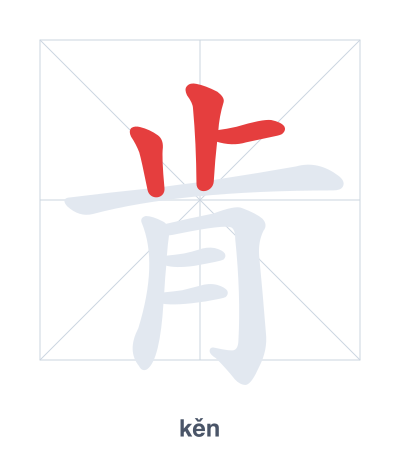
Open Hanzi Writer to see the animated stroke order and practice writing 肯 with real-time feedback.
The character 肯 (kěn) is written with 8 strokes. Follow the standard Chinese stroke order: top to bottom, left to right, outside before inside. The radical ⺼ is one of its key components.
Practice the correct stroke order with the Hanzi Writer app to see animated stroke-by-stroke guidance with real-time feedback.
肯 means to be willing to; to agree.
As an HSK Level 5 character, 肯 is an intermediate-level character.
肯 originally depicted a piece of meat (⺼) attached to a bone (the bottom component is a simplified bone shape). This image of the essential fleshy part came to signify 'to agree' or 'to be willing', as in consenting firmly.
💡 Memory Tip: Picture a person's torso (⺼) bending a knee (bottom shape) to show they are willing to kneel and agree.
我肯定会准时到。
wǒ kěn dìng huì zhǔn shí dào
I will definitely be on time.
他不肯帮我的忙。
tā bù kěn bāng wǒ de máng
He is unwilling to help me.
他工作非常肯干。
tā gōng zuò fēi cháng kěn gàn
He is a very willing worker.
Open Hanzi Writer to see the animated stroke order and practice writing 肯 with real-time feedback.
✨ Animated stroke order · Handwriting recognition · HSK-graded practice · Free to use
肯 is composed of the radical ⺼ (meat/flesh) on top and the character 止 (stop) below. The combination suggests "to stop at the flesh," which originally meant "to agree" or "to be willing" — as if one's flesh (body) stops resisting.