肠 (cháng) means "Intestine; gut." in Chinese. It has 7 strokes with the radical ⺼, and is HSK Level 5.
Rated 3.5/5 in difficulty (challenging).
Harder than 28% of HSK Level 5 characters.
Appears in 3+ common words including 香肠 (xiāng cháng), 肠胃 (cháng wèi), 肠粉 (cháng fěn).
Due to its 7 strokes, Hanzi Writer's error detection shows 肠 requires focused practice — most learners need 10+ attempts for consistent accuracy.
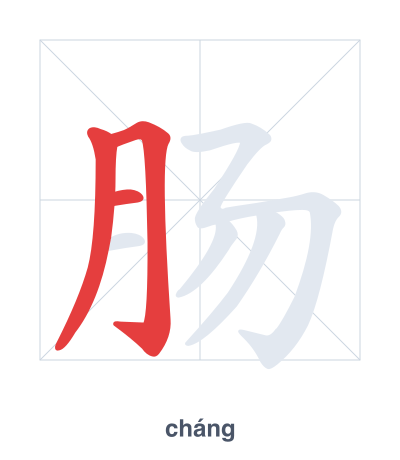
Open Hanzi Writer to see the animated stroke order and practice writing 肠 with real-time feedback.
The character 肠 (cháng) is written with 7 strokes. Follow the standard Chinese stroke order: top to bottom, left to right, outside before inside. The radical ⺼ is one of its key components.
Practice the correct stroke order with the Hanzi Writer app to see animated stroke-by-stroke guidance with real-time feedback.
肠 means Intestine; gut..
As an HSK Level 5 character, 肠 is an intermediate-level character.
肠 is a compound character: the radical ⺼ (flesh/meat) indicates it relates to a body organ, while 长 (cháng, meaning 'long') serves as a phonetic and also hints that the intestine is a long, winding tube.
💡 Memory Tip: Picture a long (长) strip of meat (⺼) coiled like an intestine inside your belly.
我喜欢吃香肠。
wǒ xǐ huān chī xiāng cháng
I like eating sausages.
我的肠胃不太舒服。
wǒ de cháng wèi bù tài shū fú
My stomach is not feeling very well.
广东的肠粉很好吃。
guǎng dōng de cháng fěn hěn hǎo chī
Guangdong's rice noodle rolls are delicious.
Open Hanzi Writer to see the animated stroke order and practice writing 肠 with real-time feedback.
✨ Animated stroke order · Handwriting recognition · HSK-graded practice · Free to use
The left component is ⺼, which is the meat radical, indicating the character relates to body parts or flesh. The right component is 长 (cháng), meaning "long," so together they suggest a "long piece of flesh" — which is the intestine.