脏 (zāng/zàng) means "dirty; internal organs" in Chinese. It has 10 strokes with the radical ⺼, and is HSK Level 2.
Rated 3.7/5 in difficulty (challenging).
Harder than 92% of HSK Level 2 characters.
Appears in 4+ common words including 肮脏 (āng zāng), 脏话 (zāng huà), 内脏 (nèi zàng).
Due to its 10 strokes, Hanzi Writer's error detection shows 脏 requires focused practice — most learners need 10+ attempts for consistent accuracy.
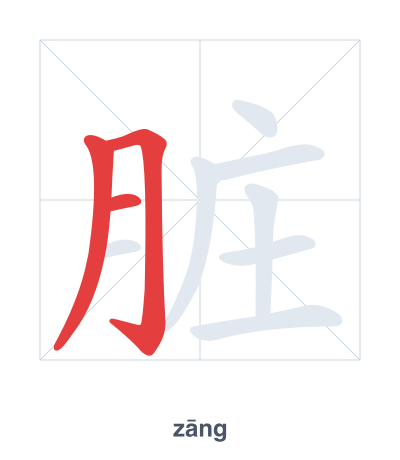
Open Hanzi Writer to see the animated stroke order and practice writing 脏 with real-time feedback.
The character 脏 (zāng/zàng) is written with 10 strokes. Follow the standard Chinese stroke order: top to bottom, left to right, outside before inside. The radical ⺼ is one of its key components.
Practice the correct stroke order with the Hanzi Writer app to see animated stroke-by-stroke guidance with real-time feedback.
脏 means dirty; internal organs.
This is a polyphonic character with readings: zāng, zàng.
As an HSK Level 2 character, 脏 is among the first characters beginners learn.
脏 combines the flesh radical ⺼ (meat/body) with 庄, originally a phonetic component. For 'internal organs', it relates to the body's solid organs; for 'dirty', it is a simplification of 髒, where 骨 (bone) and 葬 (burial) suggested decay and filth.
💡 Memory Tip: Imagine a pile of meat (⺼) and organs left in a village (庄) so long they become dirty and foul.
垃圾堆里散发出阵阵肮脏的臭气。
lā jī duī lǐ sàn fà chū zhèn zhèn āng zāng de chòu qì
A foul, dirty stench wafts from the garbage heap.
文明人说话不应该带着脏话。
wén míng rén shuō huà bù yīng gāi dài zhe zāng huà
Civilized people should not use foul language when speaking.
这种动物的内脏可以作为药材。
zhè zhǒng dòng wù de nèi zàng kě yǐ zuò wéi yào cái
The internal organs of this animal can be used as medicinal materials.
这里的面积虽小,但真是五脏俱全。
zhè lǐ de miàn jī suī xiǎo dàn zhēn shì wǔ zàng jù quán
Although the area is small, it has everything one needs.
Open Hanzi Writer to see the animated stroke order and practice writing 脏 with real-time feedback.
✨ Animated stroke order · Handwriting recognition · HSK-graded practice · Free to use
The left side is ⺼, the meat or flesh radical, which connects to the meaning 'internal organs'. The right side is 庄 (zhuāng), which gives the sound for the dirty meaning but has no direct meaning connection; the character 脏 is a simplified form that combines both 'dirty' and 'internal organs' into one character.