篷 (péng) means "canopy or sail" in Chinese. It has 16 strokes with the radical 竹, and is HSK Level 7.
Rated 4.2/5 in difficulty (advanced).
Harder than 79% of HSK Level 7 characters.
Appears in 3+ common words including 帐篷 (zhàng péng), 篷车 (péng chē), 雨篷 (yǔ péng).
Due to its 16 strokes, Hanzi Writer's error detection shows 篷 requires focused practice — most learners need 10+ attempts for consistent accuracy.
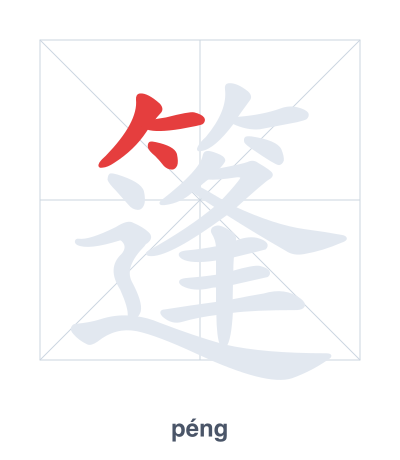
Open Hanzi Writer to see the animated stroke order and practice writing 篷 with real-time feedback.
The character 篷 (péng) is written with 16 strokes. Follow the standard Chinese stroke order: top to bottom, left to right, outside before inside. The radical 竹 is one of its key components.
Practice the correct stroke order with the Hanzi Writer app to see animated stroke-by-stroke guidance with real-time feedback.
篷 means canopy or sail.
As an HSK Level 7 character, 篷 is an intermediate-level character.
篷 combines the radical 竹 (bamboo) with the phonetic component 蓬 (péng, meaning 'overgrown' or 'flourishing'), as ancient sails and canopies were often woven from bamboo mats, creating a sheltered overhead covering.
💡 Memory Tip: Picture a bamboo (竹) canopy resembling a puffy, overgrown mushroom (蓬) stretching over a boat to catch the wind as a sail.
我们住在帐篷里。
wǒ men zhù zài zhàng péng lǐ
We live in a tent.
路上有一辆篷车。
lù shàng yǒu yī liàng péng chē
There is a covered wagon on the road.
门口有一个雨篷。
mén kǒu yǒu yí gè yǔ péng
There is a canopy at the entrance.
Open Hanzi Writer to see the animated stroke order and practice writing 篷 with real-time feedback.
✨ Animated stroke order · Handwriting recognition · HSK-graded practice · Free to use
The character 篷 consists of the radical 竹 (bamboo) on top and the phonetic component 逢 (féng) below. Bamboo was traditionally used to make mats for canopies and sails, so the top indicates the material. The bottom part suggests the idea of 'meeting' or 'covering,' which matches the function of a canopy or sail.