箍 (gū) means "hoop / to bind with a hoop" in Chinese. It has 14 strokes with the radical 竹.
Rated 4.2/5 in difficulty (advanced).
Appears in 3+ common words including 发箍 (fà gū), 铁箍 (tiě gū), 箍桶 (gū tǒng).
Due to its 14 strokes, Hanzi Writer's error detection shows 箍 requires focused practice — most learners need 10+ attempts for consistent accuracy.
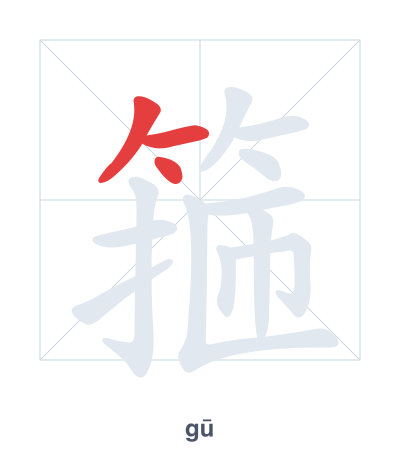
Open Hanzi Writer to see the animated stroke order and practice writing 箍 with real-time feedback.
The character 箍 (gū) is written with 14 strokes. Follow the standard Chinese stroke order: top to bottom, left to right, outside before inside. The radical 竹 is one of its key components.
Practice the correct stroke order with the Hanzi Writer app to see animated stroke-by-stroke guidance with real-time feedback.
箍 means hoop / to bind with a hoop.
The character 箍 combines the radical 竹 (bamboo) with 固 (gù, meaning solid/firm). Bamboo strips were historically used to make hoops that tightly bind barrels or buckets, emphasizing both the material and the secure fastening.
💡 Memory Tip: Picture a bamboo strip (竹) wrapping firmly around a solid round object (固) to form a tight hoop.
她戴了一个红色的发箍。
tā dài le yí gè hóng sè de fà gū
She wore a red headband.
木桶外面有一圈铁箍。
mù tǒng wài miàn yǒu yī quān tiě gū
There is an iron hoop around the wooden bucket.
那位师傅正在箍桶。
nà wèi shī fù zhèng zài gū tǒng
That master is hooping a barrel.
Open Hanzi Writer to see the animated stroke order and practice writing 箍 with real-time feedback.
✨ Animated stroke order · Handwriting recognition · HSK-graded practice · Free to use
The character 箍 is made of 竹 (bamboo) on top and 固 (firm, solid) below. Bamboo strips were historically used to make hoops that bind barrels tightly, so the components together suggest a bamboo hoop that firmly binds something.