帐 (zhàng) means "tent; account; curtain" in Chinese. It has 7 strokes with the radical 巾, and is HSK Level 7.
Rated 3.5/5 in difficulty (challenging).
Harder than 17% of HSK Level 7 characters.
Appears in 3+ common words including 帐篷 (zhàng péng), 账号 (zhàng hào), 结帐 (jié zhàng).
Due to its 7 strokes, Hanzi Writer's error detection shows 帐 requires focused practice — most learners need 10+ attempts for consistent accuracy.
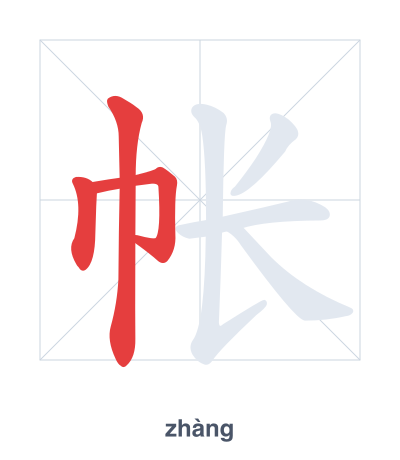
Open Hanzi Writer to see the animated stroke order and practice writing 帐 with real-time feedback.
The character 帐 (zhàng) is written with 7 strokes. Follow the standard Chinese stroke order: top to bottom, left to right, outside before inside. The radical 巾 is one of its key components.
Practice the correct stroke order with the Hanzi Writer app to see animated stroke-by-stroke guidance with real-time feedback.
帐 means tent; account; curtain.
As an HSK Level 7 character, 帐 is an intermediate-level character.
帐 is composed of 巾 (cloth) on the left and 长 (long) on the right. The 巾 radical shows it relates to cloth, while 长 gives the sound and hints at something stretched out. Originally, it meant a curtain or canopy made of cloth, which later extended to mean a tent and then an account (as in a record kept on cloth or paper).
💡 Memory Tip: Imagine a long (长) piece of cloth (巾) stretched out to make a tent (帐) — and inside that tent, you keep a list of numbers on an account sheet.
我们在山里搭帐篷。
wǒ men zài shān lǐ dā zhàng péng
We are setting up a tent in the mountains.
请输入你的账号。
qǐng shū rù nǐ de zhàng hào
Please enter your account number.
服务员,我要结帐。
fú wù yuán wǒ yào jié zhàng
Waiter, I'd like to pay the bill.
Open Hanzi Writer to see the animated stroke order and practice writing 帐 with real-time feedback.
✨ Animated stroke order · Handwriting recognition · HSK-graded practice · Free to use
帐 combines the radical 巾 (cloth) with 长 (long). The cloth radical signals that the character is about fabric, while 长 suggests something extended or stretched. Together, they show a long piece of cloth, which was originally a curtain or canopy. Over time, this meaning expanded to include tents (made of cloth) and then accounts (since records were often kept on cloth or paper).