陪 (péi) means "to accompany" in Chinese. It has 10 strokes with the radical 阝, and is HSK Level 5.
Rated 3.9/5 in difficulty (challenging).
Harder than 47% of HSK Level 5 characters.
Appears in 3+ common words including 陪我 (péi wǒ), 陪伴 (péi bàn), 陪同 (péi tóng).
Due to its 10 strokes, Hanzi Writer's error detection shows 陪 requires focused practice — most learners need 10+ attempts for consistent accuracy.
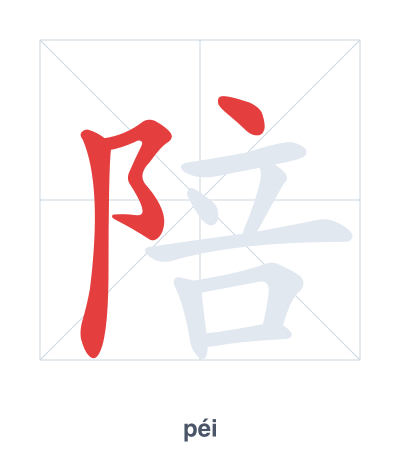
Open Hanzi Writer to see the animated stroke order and practice writing 陪 with real-time feedback.
The character 陪 (péi) is written with 10 strokes. Follow the standard Chinese stroke order: top to bottom, left to right, outside before inside. The radical 阝 is one of its key components.
Practice the correct stroke order with the Hanzi Writer app to see animated stroke-by-stroke guidance with real-time feedback.
陪 means to accompany.
As an HSK Level 5 character, 陪 is an intermediate-level character.
The left radical 阝 (阜) originally depicted a mound or hill, while the right component 咅 (pǒu) provides phonetic guidance. Together, the character 陪 originally referred to a secondary or adjacent mound, which extended metaphorically to mean to accompany or be by someone's side.
💡 Memory Tip: Picture the left ear (阝) listening as the right side's mouth (口) speaks, so you stay close to accompany the speaker.
请你陪我去超市。
qǐng nǐ péi wǒ qù chāo shì
Please go to the supermarket with me.
狗狗一直陪伴着我。
gǒu gǒu yì zhí péi bàn zhe wǒ
The dog has always been with me.
秘书陪同经理开会。
mì shū péi tóng jīng lǐ kāi huì
The secretary accompanied the manager to the meeting.
Open Hanzi Writer to see the animated stroke order and practice writing 陪 with real-time feedback.
✨ Animated stroke order · Handwriting recognition · HSK-graded practice · Free to use
The character 陪 is made of the left radical 阝 (meaning hill or mound) and the right part 咅 (which contains 立 'stand' and 口 'mouth'). The radical suggests a place, and the meaning 'to accompany' comes from the idea of standing by someone's side, though the components are mostly phonetic.