邾 (zhū) means "Zhu (ancient state name)" in Chinese. It has 8 strokes with the radical 阝.
Rated 3.4/5 in difficulty (challenging).
Appears in 3+ common words including 邾国 (zhū guó), 邾城 (zhū chéng), 姓邾 (xìng zhū).
Due to its 8 strokes, Hanzi Writer's error detection shows 邾 requires focused practice — most learners need 10+ attempts for consistent accuracy.
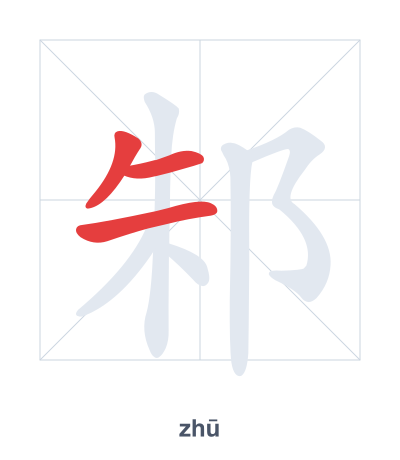
Open Hanzi Writer to see the animated stroke order and practice writing 邾 with real-time feedback.
The character 邾 (zhū) is written with 8 strokes. Follow the standard Chinese stroke order: top to bottom, left to right, outside before inside. The radical 阝 is one of its key components.
Practice the correct stroke order with the Hanzi Writer app to see animated stroke-by-stroke guidance with real-time feedback.
邾 means Zhu (ancient state name).
邾 is a compound character with 朱 (zhū, 'red') as the phonetic component and 阝 (a hill or town) as the semantic radical, indicating it was the name of an ancient city-state. The 朱 element likely gave both the pronunciation and a hint of local red soil or cultural identity.
💡 Memory Tip: Imagine a town (阝) painted entirely in vermilion (朱) to remember the ancient state of 邾.
邾国是古代的小国。
zhū guó shì gǔ dài de xiǎo guó
The State of Zhu was a small ancient state.
邾城是一个古老的地方。
zhū chéng shì yí gè gǔ lǎo de dì fāng
Zhucheng is an ancient place.
姓邾的人并不多。
xìng zhū de rén bìng bù duō
There are not many people with the surname Zhu.
Open Hanzi Writer to see the animated stroke order and practice writing 邾 with real-time feedback.
✨ Animated stroke order · Handwriting recognition · HSK-graded practice · Free to use
邾 is composed of the radical 阝 (meaning "hill" or "place") on the left and 朱 (zhū, meaning "red") on the right. Since 阝 often indicates a location or state, 邾 refers to the ancient State of Zhu. This structure shows it is a place name, not a color.