郁 (yù) means "gloomy / lush / fragrant" in Chinese. It has 8 strokes with the radical 阝, and is HSK Level 7.
Rated 3.4/5 in difficulty (challenging).
Harder than 14% of HSK Level 7 characters.
Appears in 3+ common words including 郁金香 (yù jīn xiāng), 忧郁 (yōu yù), 葱郁 (cōng yù).
Due to its 8 strokes, Hanzi Writer's error detection shows 郁 requires focused practice — most learners need 10+ attempts for consistent accuracy.
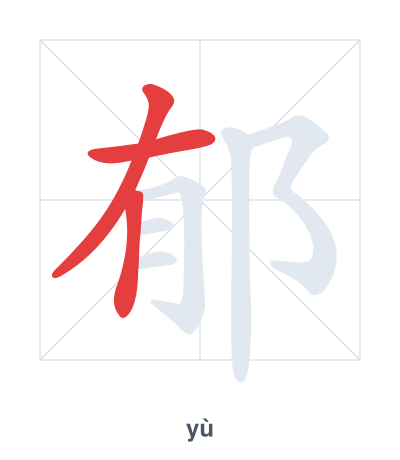
Open Hanzi Writer to see the animated stroke order and practice writing 郁 with real-time feedback.
The character 郁 (yù) is written with 8 strokes. Follow the standard Chinese stroke order: top to bottom, left to right, outside before inside. The radical 阝 is one of its key components.
Practice the correct stroke order with the Hanzi Writer app to see animated stroke-by-stroke guidance with real-time feedback.
郁 means gloomy / lush / fragrant.
As an HSK Level 7 character, 郁 is an intermediate-level character.
The character 郁 consists of the radical 阝 (a hill) and the component 有 (to have/abundant). Originally it depicted a hill with abundant vegetation, giving the meanings 'lush' and 'fragrant' (from flowers), while dense foliage also led to the sense of 'gloomy' (blocking light).
💡 Memory Tip: Picture a hill (阝) that has (有) such thick, lush vegetation it feels gloomy and smells fragrant.
公园里有很多郁金香。
gōng yuán lǐ yǒu hěn duō yù jīn xiāng
There are many tulips in the park.
他最近心情很忧郁。
tā zuì jìn xīn qíng hěn yōu yù
He has been in a very melancholy mood lately.
这里的树木非常葱郁。
zhè lǐ de shù mù fēi cháng cōng yù
The trees here are very lush and green.
Open Hanzi Writer to see the animated stroke order and practice writing 郁 with real-time feedback.
✨ Animated stroke order · Handwriting recognition · HSK-graded practice · Free to use
郁 is composed of the radical 阝 (representing a place or mound) on the left and the phonetic component 有 on the right. The original meaning related to a place name, but over time it came to express the feeling of being pent up (gloomy) and also lush vegetation. The radical hints at a location, while the sound component provides the pronunciation yù.