伴 (bàn) means "companion; partner" in Chinese. It has 7 strokes with the radical 亻, and is HSK Level 4.
Rated 3.2/5 in difficulty (challenging).
Harder than 16% of HSK Level 4 characters.
Appears in 3+ common words including 伙伴 (huǒ bàn), 陪伴 (péi bàn), 伴侣 (bàn lǚ).
Due to its 7 strokes, Hanzi Writer's error detection shows 伴 requires focused practice — most learners need 10+ attempts for consistent accuracy.
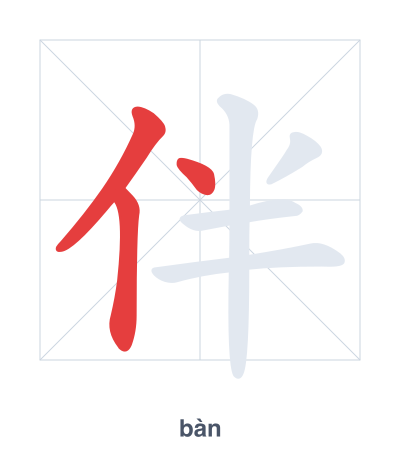
Open Hanzi Writer to see the animated stroke order and practice writing 伴 with real-time feedback.
The character 伴 (bàn) is written with 7 strokes. Follow the standard Chinese stroke order: top to bottom, left to right, outside before inside. The radical 亻 is one of its key components.
Practice the correct stroke order with the Hanzi Writer app to see animated stroke-by-stroke guidance with real-time feedback.
伴 means companion; partner.
As an HSK Level 4 character, 伴 is an intermediate-level character.
伴 is a compound character combining the radical 亻 (person) with 半 (half). The component 半 originally depicted an ox split in two parts, symbolizing 'half'. Together, 伴 literally means 'a person who is half of a pair'—a companion or partner.
💡 Memory Tip: Imagine a person (亻) splitting themselves in half (半) to create a perfect companion by your side.
他是我的好伙伴。
tā shì wǒ de hǎo huǒ bàn
He is my good partner.
谢谢你陪伴我。
xiè xiè nǐ péi bàn wǒ
Thank you for keeping me company.
他们是理想的伴侣。
tā men shì lǐ xiǎng de bàn lǚ
They are ideal partners.
Open Hanzi Writer to see the animated stroke order and practice writing 伴 with real-time feedback.
✨ Animated stroke order · Handwriting recognition · HSK-graded practice · Free to use
The character 伴 combines the radical 亻 (person) on the left with 半 (half) on the right. A "companion" is a person who shares half of your journey or work with you. This structure shows that the meaning comes from a person (亻) who is like your "other half" (半).