偶 (ǒu) means "By chance / Even number / Idol" in Chinese. It has 11 strokes with the radical 亻, and is HSK Level 5.
Rated 3.9/5 in difficulty (challenging).
Harder than 43% of HSK Level 5 characters.
Appears in 3+ common words including 偶然 (ǒu rán), 偶像 (ǒu xiàng), 偶数 (ǒu shù).
Due to its 11 strokes, Hanzi Writer's error detection shows 偶 requires focused practice — most learners need 10+ attempts for consistent accuracy.
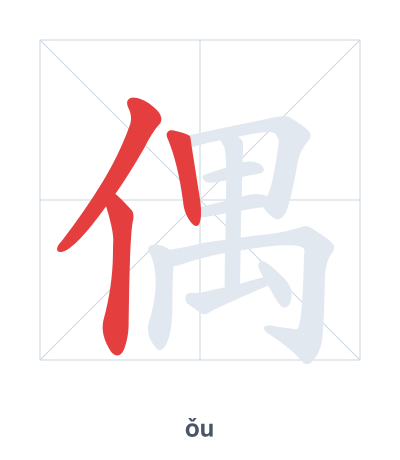
Open Hanzi Writer to see the animated stroke order and practice writing 偶 with real-time feedback.
The character 偶 (ǒu) is written with 11 strokes. Follow the standard Chinese stroke order: top to bottom, left to right, outside before inside. The radical 亻 is one of its key components.
Practice the correct stroke order with the Hanzi Writer app to see animated stroke-by-stroke guidance with real-time feedback.
偶 means By chance / Even number / Idol.
As an HSK Level 5 character, 偶 is an intermediate-level character.
偶 combines the person radical 亻 with 禺, an ancient pictograph of a carved wooden figure used in rituals; this human-shaped idol later gave rise to the extended meanings of 'by chance' (as in accidental pairing) and 'even number' (a pair).
💡 Memory Tip: Imagine a person (亻) carving a wooden idol (禺) that accidentally splits into two identical halves—an even pair by chance.
这是一个偶然的机会。
zhè shì yí gè ǒu rán de jī huì
This is a chance opportunity.
他是我的偶像。
tā shì wǒ de ǒu xiàng
He is my idol.
二是一个偶数。
èr shì yí gè ǒu shù
Two is an even number.
Open Hanzi Writer to see the animated stroke order and practice writing 偶 with real-time feedback.
✨ Animated stroke order · Handwriting recognition · HSK-graded practice · Free to use
The left side is the person radical 亻, which indicates a person. The right side is 禺, which originally meant a mask or spirit, so together they suggest a person wearing a mask — this connects to the idea of an 'idol' (a persona) or an accidental encounter (like meeting someone unexpected).