别 (bié/biè) means "Don't / Other." in Chinese. It has 7 strokes with the radical 刂, and is HSK Level 1.
Rated 2.7/5 in difficulty (moderate).
Harder than 38% of HSK Level 1 characters.
Appears in 3+ common words including 区别 (qū bié), 离别 (lí bié), 别扭 (biè niǔ).
Hanzi Writer's stroke validation shows learners typically need 5-8 attempts to write 别 with correct proportion and order.
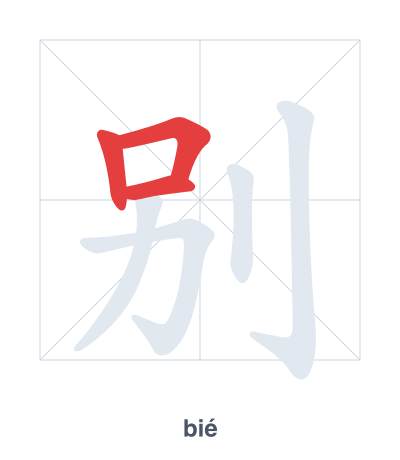
Open Hanzi Writer to see the animated stroke order and practice writing 别 with real-time feedback.
The character 别 (bié/biè) is written with 7 strokes. Follow the standard Chinese stroke order: top to bottom, left to right, outside before inside. The radical 刂 is one of its key components.
Practice the correct stroke order with the Hanzi Writer app to see animated stroke-by-stroke guidance with real-time feedback.
别 means Don't / Other..
This is a polyphonic character with readings: bié, biè.
As an HSK Level 1 character, 别 is among the first characters beginners learn.
The character 别 combines 另 (another/separate) with the radical 刂 (knife), originally depicting the act of cutting something apart or separating. This gave rise to the meanings 'other' (that which is separate) and the negative imperative 'don't' (as in 'separate yourself from that action').
💡 Memory Tip: Picture a knife (刂) slicing through a scene where someone is about to do something wrong, and a voice shouts 'Don't!' as the blade separates them from the 'other' (另) option.
这两个词在用法上存在细微的区别。
zhè liǎng gè cí zài yòng fǎ shàng cún zài xì wēi de qū bié
There are subtle differences in the usage of these two words.
离别的时刻总是让人感到难分难舍。
lí bié de shí kè zǒng shì ràng rén gǎn dào nán fēn nán shě 。
The moment of parting always makes people feel reluctant to say goodbye.
他今天心情不好,说话总是很别扭。
tā jīn tiān xīn qíng bù hǎo shuō huà zǒng shì hěn biè niǔ
He is in a bad mood today and always speaks in a prickly way.
Open Hanzi Writer to see the animated stroke order and practice writing 别 with real-time feedback.
✨ Animated stroke order · Handwriting recognition · HSK-graded practice · Free to use
别 is made of 另 (yì, meaning 'other' or 'another') on the left and the knife radical 刂 on the right. The knife suggests separation or cutting, which together with 'other' gives the meanings 'to separate' (as in 离别) and the imperative 'don't' (as in cutting off an action).