钟 (zhōng) means "Clock/Bell" in Chinese. It has 9 strokes with the radical 钅, and is HSK Level 2.
Rated 3.5/5 in difficulty (challenging).
Harder than 69% of HSK Level 2 characters.
Appears in 3+ common words including 时钟 (shí zhōng), 闹钟 (nào zhōng), 分钟 (fēn zhōng).
Due to its 9 strokes, Hanzi Writer's error detection shows 钟 requires focused practice — most learners need 10+ attempts for consistent accuracy.
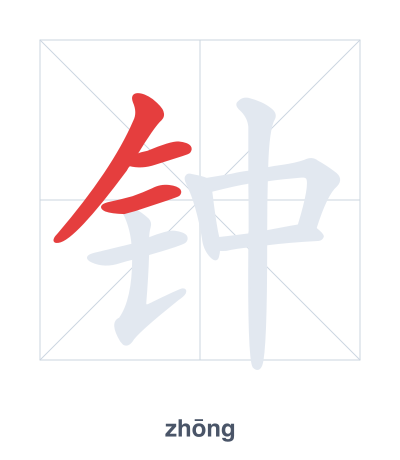
Open Hanzi Writer to see the animated stroke order and practice writing 钟 with real-time feedback.
The character 钟 (zhōng) is written with 9 strokes. Follow the standard Chinese stroke order: top to bottom, left to right, outside before inside. The radical 钅 is one of its key components.
Practice the correct stroke order with the Hanzi Writer app to see animated stroke-by-stroke guidance with real-time feedback.
钟 means Clock/Bell.
As an HSK Level 2 character, 钟 is among the first characters beginners learn.
The character 钟 combines the metal radical 钅 (gold/metal) with 中 (middle, center), indicating a metal bell that hangs in the center of a frame. Originally it represented a bell or wine vessel, and later came to mean 'clock' by extension of the bell's function of sounding the hours.
💡 Memory Tip: Picture a golden bell (钅) hanging right in the middle (中) of a tall clock tower.
墙上的时钟停了。
qiáng shàng de shí zhōng tíng le
The clock on the wall has stopped.
我的闹钟响了。
wǒ de nào zhōng xiǎng le
My alarm clock went off.
请等我五分钟。
qǐng děng wǒ wǔ fēn zhōng
Please wait for me for five minutes.
Open Hanzi Writer to see the animated stroke order and practice writing 钟 with real-time feedback.
✨ Animated stroke order · Handwriting recognition · HSK-graded practice · Free to use
The left side is the radical 钅, meaning metal, which indicates that bells and clocks are often made of metal. The right side is 中 (zhōng), which hints at the pronunciation and also suggests 'center' — as in a bell's sound coming from the center.