膜 (mó) means "membrane; film" in Chinese. It has 14 strokes with the radical ⺼, and is HSK Level 6.
Rated 4.2/5 in difficulty (advanced).
Harder than 86% of HSK Level 6 characters.
Appears in 3+ common words including 面膜 (miàn mó), 贴膜 (tiē mó), 耳膜 (ěr mó).
Due to its 14 strokes, Hanzi Writer's error detection shows 膜 requires focused practice — most learners need 10+ attempts for consistent accuracy.
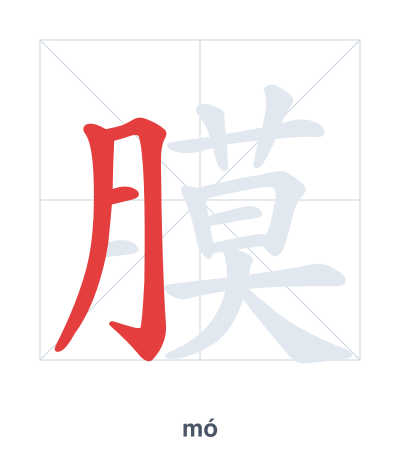
Open Hanzi Writer to see the animated stroke order and practice writing 膜 with real-time feedback.
The character 膜 (mó) is written with 14 strokes. Follow the standard Chinese stroke order: top to bottom, left to right, outside before inside. The radical ⺼ is one of its key components.
Practice the correct stroke order with the Hanzi Writer app to see animated stroke-by-stroke guidance with real-time feedback.
膜 means membrane; film.
As an HSK Level 6 character, 膜 is an intermediate-level character.
膜 is a phono-semantic compound. The left radical ⺼ (flesh/body) indicates it relates to bodily tissues, while the right component 莫 provides the pronunciation mó and also visually suggests a covering—like a membrane enveloping flesh.
💡 Memory Tip: Picture a thin film (膜) stretched over a slab of raw meat (⺼), with the right side 莫 looking like a grassy cover (艹) shielding a sun (日) beneath a large sheet (大).
她每天敷面膜。
tā měi tiān fū miàn mó
She applies a facial mask every day.
手机需要贴膜。
shǒu jī xū yào tiē mó
The phone needs a screen protector.
他的耳膜受伤了。
tā de ěr mó shòu shāng le
His eardrum is injured.
Open Hanzi Writer to see the animated stroke order and practice writing 膜 with real-time feedback.
✨ Animated stroke order · Handwriting recognition · HSK-graded practice · Free to use
The left side is ⺼, a variant of 月 (flesh/body), which connects to body parts. The right side is 莫 (mò), which gives the sound and also suggests "covering" or "not" — together they create the idea of a thin covering on the body, like a membrane or film.