贴 (tiē) means "Paste; stick; subsidize" in Chinese. It has 9 strokes with the radical 贝, and is HSK Level 4.
Rated 4/5 in difficulty (challenging).
Harder than 63% of HSK Level 4 characters.
Appears in 3+ common words including 贴纸 (tiē zhǐ), 补贴 (bǔ tiē), 贴心 (tiē xīn).
Due to its 9 strokes, Hanzi Writer's error detection shows 贴 requires focused practice — most learners need 10+ attempts for consistent accuracy.
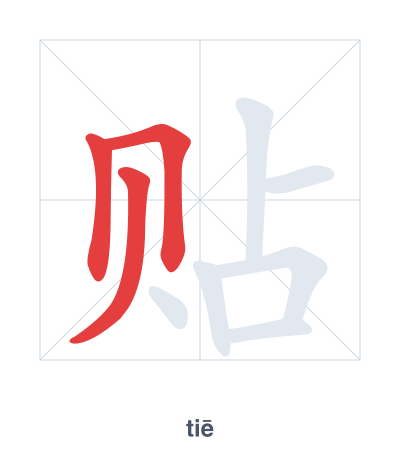
Open Hanzi Writer to see the animated stroke order and practice writing 贴 with real-time feedback.
The character 贴 (tiē) is written with 9 strokes. Follow the standard Chinese stroke order: top to bottom, left to right, outside before inside. The radical 贝 is one of its key components.
Practice the correct stroke order with the Hanzi Writer app to see animated stroke-by-stroke guidance with real-time feedback.
贴 means Paste; stick; subsidize.
As an HSK Level 4 character, 贴 is an intermediate-level character.
贴 combines the radical 贝 (shell/money) with 占 (to divine, also phonetic tiē). The shell component hints at a transfer of value, linking to the meaning 'subsidize,' while the overall structure suggests sticking something onto a surface, like attaching a shell as payment or a note.
💡 Memory Tip: Imagine using a shell (贝) as glue to stick a fortune-telling slip (占) onto a wall—pasting it in place.
孩子喜欢玩贴纸。
hái zi xǐ huān wán tiē zhǐ
Children like playing with stickers.
公司有交通补贴。
gōng sī yǒu jiāo tōng bǔ tiē
The company provides a transportation allowance.
他的服务很贴心。
tā de fú wù hěn tiē xīn
His service is very thoughtful and considerate.
Open Hanzi Writer to see the animated stroke order and practice writing 贴 with real-time feedback.
✨ Animated stroke order · Handwriting recognition · HSK-graded practice · Free to use
贴 consists of two parts: the left radical 贝 (shell or money) and the right component 占 (to occupy). The 贝 radical connects to the meaning "subsidize" (giving money), while the combination suggests attaching or occupying a surface, relating to "paste" and "stick."