腔 (qiāng) means "Cavity / Chamber / Accent" in Chinese. It has 12 strokes with the radical ⺼, and is HSK Level 7.
Rated 4.2/5 in difficulty (advanced).
Harder than 83% of HSK Level 7 characters.
Appears in 3+ common words including 口腔 (kǒu qiāng), 腔调 (qiāng diào), 胸腔 (xiōng qiāng).
Due to its 12 strokes, Hanzi Writer's error detection shows 腔 requires focused practice — most learners need 10+ attempts for consistent accuracy.
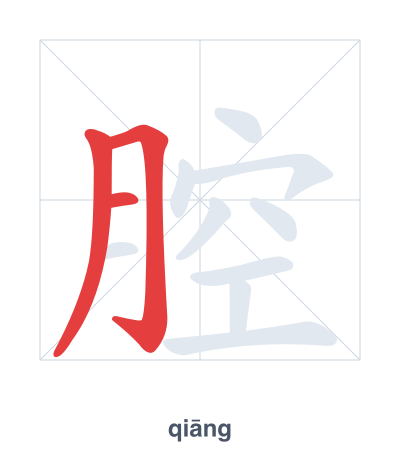
Open Hanzi Writer to see the animated stroke order and practice writing 腔 with real-time feedback.
The character 腔 (qiāng) is written with 12 strokes. Follow the standard Chinese stroke order: top to bottom, left to right, outside before inside. The radical ⺼ is one of its key components.
Practice the correct stroke order with the Hanzi Writer app to see animated stroke-by-stroke guidance with real-time feedback.
腔 means Cavity / Chamber / Accent.
As an HSK Level 7 character, 腔 is an intermediate-level character.
The character 腔 combines the radical ⺼ (flesh/body part) with 空 (empty/hollow), indicating a hollow space within the body like a chest or oral cavity. This structure logically extends to any enclosed hollow space (chamber) and figuratively to the characteristic tone or resonance of speech (accent).
💡 Memory Tip: Picture a slab of meat (⺼) with a hole (空) carved out of it, creating a hollow cavity inside.
保持口腔清洁。
bǎo chí kǒu qiāng qīng jié
Maintain oral hygiene.
他的腔调很有趣。
tā de qiāng diào hěn yǒu qù
His accent is very interesting.
他的胸腔很宽阔。
tā de xiōng qiāng hěn kuān kuò
His chest cavity is very broad.
Open Hanzi Writer to see the animated stroke order and practice writing 腔 with real-time feedback.
✨ Animated stroke order · Handwriting recognition · HSK-graded practice · Free to use
The left side ⺼ (meat/flesh radical) relates to the body, and the right side 空 (kōng, meaning empty) suggests a hollow space. Together they form the idea of a cavity or chamber in the body, such as 口腔 (oral cavity) or 胸腔 (chest cavity).