耳 (ěr) means "ear" in Chinese. It has 6 strokes with the radical 耳, and is HSK Level 4.
Rated 2.9/5 in difficulty (moderate).
Harder than 13% of HSK Level 4 characters.
Appears in 3+ common words including 耳朵 (ěr duǒ), 耳机 (ěr jī), 木耳 (mù ěr).
Hanzi Writer's stroke validation shows learners typically need 5-8 attempts to write 耳 with correct proportion and order.
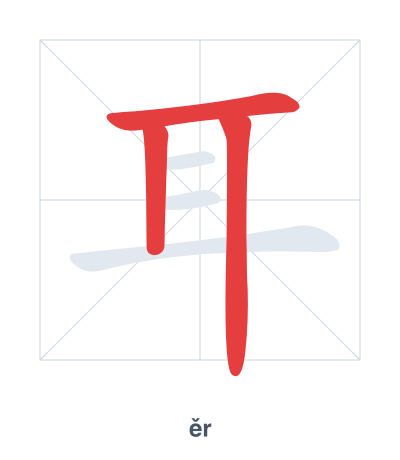
Open Hanzi Writer to see the animated stroke order and practice writing 耳 with real-time feedback.
The character 耳 (ěr) is written with 6 strokes. Follow the standard Chinese stroke order: top to bottom, left to right, outside before inside. The radical 耳 is one of its key components.
Practice the correct stroke order with the Hanzi Writer app to see animated stroke-by-stroke guidance with real-time feedback.
耳 means ear.
As an HSK Level 4 character, 耳 is an intermediate-level character.
耳 is a pictograph that originally depicted an ear, with the outer curve representing the outer ear and the inner strokes suggesting the inner structure. Over time, it simplified into the modern form, but the shape still vaguely resembles a side-view ear with a central opening.
💡 Memory Tip: Imagine the two vertical strokes in the middle are the ear canal, and the outer frame is the curved outer ear, so the whole shape looks like an ear listening intently.
兔子的耳朵很长。
tù zi de ěr duǒ hěn zhǎng
A rabbit's ears are very long.
我戴着耳机听音乐。
wǒ dài zhe ěr jī tīng yīn yuè
I'm wearing headphones listening to music.
我喜欢吃凉拌木耳。
wǒ xǐ huān chī liáng bàn mù ěr
I like eating cold wood ear mushroom salad.
Open Hanzi Writer to see the animated stroke order and practice writing 耳 with real-time feedback.
✨ Animated stroke order · Handwriting recognition · HSK-graded practice · Free to use
耳 is a pictograph that looks like a human ear. It is both the character itself and its own radical, so there are no separate components to break down. The shape directly represents the external ear, which is why it means 'ear'.