面 (miàn) means "Face; surface; noodles; flour" in Chinese. It has 9 strokes with the radical 面, and is HSK Level 1.
Rated 2.8/5 in difficulty (moderate).
Harder than 50% of HSK Level 1 characters.
Appears in 3+ common words including 面包 (miàn bāo), 见面 (jiàn miàn), 面条 (miàn tiáo).
Hanzi Writer's stroke validation shows learners typically need 5-8 attempts to write 面 with correct proportion and order.
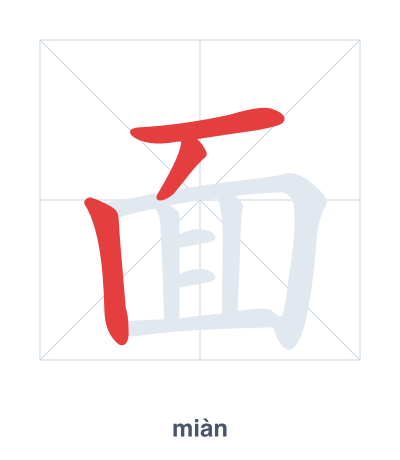
Open Hanzi Writer to see the animated stroke order and practice writing 面 with real-time feedback.
The character 面 (miàn) is written with 9 strokes. Follow the standard Chinese stroke order: top to bottom, left to right, outside before inside. The radical 面 is one of its key components.
Practice the correct stroke order with the Hanzi Writer app to see animated stroke-by-stroke guidance with real-time feedback.
面 means Face; surface; noodles; flour.
As an HSK Level 1 character, 面 is among the first characters beginners learn.
The character 面 originally depicted a human face with an eye (the square shape outlines the face, and the inner part represents the eye and nose area). It was a pictograph of a face, which later extended to mean 'surface' (like the face of an object) and then 'noodles' (as a food made from flour, which is a fine powder or surface-like substance).
💡 Memory Tip: Imagine the square outline as a noodle bowl, and the inner vertical lines as chopsticks dipping into flour-covered noodles, with the whole shape representing a face peering into the bowl.
我喜欢吃面包。
wǒ xǐ huān chī miàn bāo
I like eating bread.
我们明天见面吧。
wǒ men míng tiān jiàn miàn ba
Let's meet tomorrow.
这一碗面条很好吃。
zhè yī wǎn miàn tiáo hěn hǎo chī
This bowl of noodles is delicious.
Open Hanzi Writer to see the animated stroke order and practice writing 面 with real-time feedback.
✨ Animated stroke order · Handwriting recognition · HSK-graded practice · Free to use
The character 面 is a pictograph that looks like a face with a nose and eyes. Its basic meaning is "face" or "surface," which then extends to "side" and "flour" (as in the surface of ground grain). The radical is also 面, so it functions as both the component and the whole character.