扭 (niǔ) means "to twist; to sprain; to turn around" in Chinese. It has 7 strokes with the radical 扌, and is HSK Level 6.
Rated 3.5/5 in difficulty (challenging).
Harder than 19% of HSK Level 6 characters.
Appears in 3+ common words including 扭伤 (niǔ shāng), 扭头 (niǔ tóu), 别扭 (biè niǔ).
Due to its 7 strokes, Hanzi Writer's error detection shows 扭 requires focused practice — most learners need 10+ attempts for consistent accuracy.
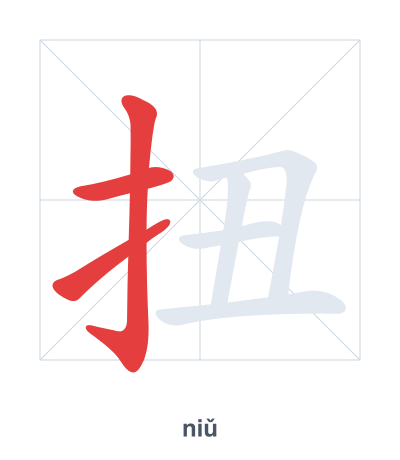
Open Hanzi Writer to see the animated stroke order and practice writing 扭 with real-time feedback.
The character 扭 (niǔ) is written with 7 strokes. Follow the standard Chinese stroke order: top to bottom, left to right, outside before inside. The radical 扌 is one of its key components.
Practice the correct stroke order with the Hanzi Writer app to see animated stroke-by-stroke guidance with real-time feedback.
扭 means to twist; to sprain; to turn around.
As an HSK Level 6 character, 扭 is an intermediate-level character.
扭 is a phono-semantic compound: the hand radical (扌) indicates the action is performed with the hand, and 丑 (originally a pictograph of a twisted knot) provides the sound and reinforces the meaning of twisting or turning.
💡 Memory Tip: Picture a hand (扌) violently twisting an ugly (丑) rubber band until it snaps.
他的脚扭伤了。
tā de jiǎo niǔ shāng le
He sprained his foot.
他扭头看了看。
tā niǔ tóu kàn le kàn
He turned his head to look.
这种感觉很别扭。
zhè zhǒng gǎn jué hěn biè niǔ
This feeling is very awkward.
Open Hanzi Writer to see the animated stroke order and practice writing 扭 with real-time feedback.
✨ Animated stroke order · Handwriting recognition · HSK-graded practice · Free to use
The left side is the radical 扌 (hand), indicating the action involves the hands. The right side 丑 provides the pronunciation niǔ and originally related to twisting or bending, so the whole character means to twist or turn with the hands.